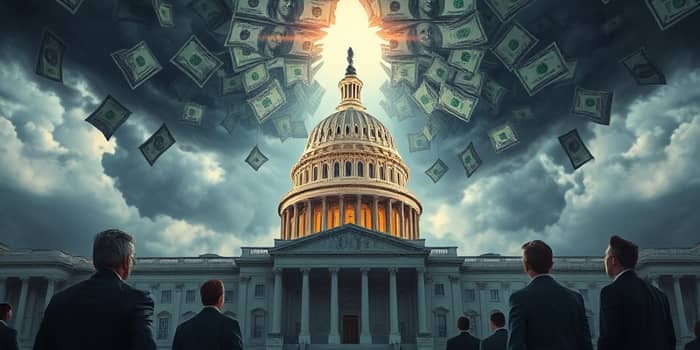
The recurring standoff over the U.S. debt ceiling often appears as political theater, but its consequences for markets, confidence, and real economic activity are profound. In early 2025, the federal government hit the cap at $36.1 trillion, setting the stage for another heated debate on whether to raise or suspend this borrowing limit.
Far from a vote on new spending, the debt ceiling simply authorizes the Treasury to fund obligations Congress has already approved. Yet, the risk of default, even if ultimately avoided, can shake financial markets and damage confidence in the nation’s creditworthiness.
Origins and Purpose: What the Debt Ceiling Is—and Isn’t
The debt limit dates back to World War I, when Congress shifted from approving individual bond issues to setting an aggregate borrowing cap. Its original intent was to streamline wartime finance, not to serve as a recurring congressional bargaining chip.
Today, the ceiling represents the total amount the federal government is authorized to borrow to meet existing legal obligations, including Social Security and Medicare benefits, military salaries, and interest on the national debt. Raising the ceiling does not authorize new programs or expansions—it allows the Treasury to cover commitments already enacted.
Historical Precedence: A Routine or a Reckless Gamble?
Since 1960, Congress has acted 78 times to raise, extend, or revise the debt limit: 49 times under Republican presidents and 29 under Democrats. The pattern suggests that adjustments are routine governance rather than extraordinary events—yet they have become increasingly politicized.
During the 2011 stand-off, Standard & Poor’s downgraded U.S. credit from AAA to AA+, illustrating how brinkmanship can inflict long-lasting reputational harm. Fitch later placed the rating on watch negative during another standoff, underscoring persistent concerns.
Key Figures: The Latest Numbers
On January 1, 2025, the Treasury reached its borrowing limit at $36.1 trillion. In July 2025, Congress approved the One Big Beautiful Bill Act, raising the ceiling by $5 trillion to $41.1 trillion. As of January 12, 2026, federal debt stood at $38.4 trillion.
Economic Channels: Why Economists Worry
- Interest rates on short-term Treasuries can spike as investors demand risk premiums.
- Higher Treasury yields ripple through mortgages, auto loans, and corporate borrowing.
- Stock market volatility intensifies, unsettling retirement accounts and portfolios.
- Consumer and business confidence falters amid uncertainty over government payments.
During the 2023 episode, yields on bills maturing June 1 jumped from 4.4% to 5.7% between mid-April and May 22, a sign investors priced in default risk earlier and more steeply than in previous episodes.
Potential Consequences: From Recession Risk to Currency Status
Failure to lift the ceiling could force the Treasury to rely on cash and “extraordinary measures” before exhausting funds. Brookings estimates that without new borrowing, non-interest spending would need to be slashed by over 35%—a draconian cut that would shutter essential programs.
- Roosevelt Institute warns a short default could cost half a million jobs.
- A longer stalemate might eliminate 8.3 million jobs and raise unemployment by 5 points.
- Cato Institute predicts rapid interest-rate surges, inflation spikes, and steeper cuts to services.
A default shock could darken economic growth prospects, elevate borrowing costs for businesses and households, and even threaten the dollar’s standing as the world’s reserve currency.
Political Dynamics: A Recurring Brinkmanship
At its core, the debt ceiling debate has become a political sticking point. Some lawmakers view it as an enforcement mechanism for fiscal discipline, leveraging the threat of default to extract spending concessions. Others argue it is economically irrational hostage-taking that endangers the nation’s credit.
The Treasury repeatedly points out that the ceiling debate is not about future budgets, but about meeting obligations that Congress and presidents of both parties have already made. Yet, the political incentives to hold out for policy victories keep the cycle alive.
Market Reactions Before Default
Evidence shows markets react well before any payment is missed. Treasury bills often trade at a higher yield premium, reflecting the closest maturity to potential default. Short-term funding markets can become distorted as firms hesitate to lend against Treasury collateral.
Investors may even question payment priority, anticipating that if forced, the Treasury would have to choose which obligations to honor first—adding another layer of uncertainty to an already fragile environment.
Reform and Abolition: Is There a Better Way?
Economists and policy experts have proposed various reforms:
- Automatic increases tied to spending and revenue forecasts.
- Abolishing the debt ceiling altogether, as suggested by Brookings and Roosevelt Institute.
- Converting it into a real annual budget enforcement rule, rather than a standalone limit.
Such changes could strip the mechanism of its status as a periodic source of market stress and political brinkmanship, ensuring the U.S. never again approaches the brink of default over obligations long since approved.
Conclusion: The High Stakes of Avoiding Default
The debt ceiling debate is more than congressional drama; it is a test of market confidence, financial stability, and economic resilience. While history shows Congress has ultimately acted to avert default, the process inflicts measurable cost—higher interest rates, shaken confidence, and potential reputation loss.
Recognizing that lifting the ceiling is merely fulfilling pre-existing laws may help reframe the discussion. Until the structural issues are addressed, the cycle is likely to repeat, each time with higher stakes for the U.S. economy and the global financial system.
References
- https://rooseveltinstitute.org/blog/the-debt-ceiling-fight-is-a-dire-economic-risk-and-a-false-debate/
- https://www.brookings.edu/articles/the-hutchins-center-explains-the-debt-limit/
- https://www.brookings.edu/articles/the-economics-of-the-debt-ceiling-debate/
- https://www.schwab.com/learn/story/what-is-debt-ceiling
- https://business.columbia.edu/insights/finance-economics/debt-ceiling-deal-and-its-economic-fallout
- https://home.treasury.gov/policy-issues/financial-markets-financial-institutions-and-fiscal-service/debt-limit
- https://www.cato.org/blog/debt-ceiling-crisis-debt-crisis
- https://www.us-debt-clock.com/debt-ceiling
- https://yipinstitute.org/policy/debt-ceiling-dilemma-evaluating-its-necessity-economic-impact-and-solutions
- https://www.crfb.org/blogs/upcoming-congressional-fiscal-policy-deadlines
- https://www.cfr.org/backgrounders/what-happens-when-us-hits-its-debt-ceiling
- https://www.jec.senate.gov/public/index.cfm/republicans/debt-dashboard
- https://www.crfb.org/papers/qa-everything-you-should-know-about-debt-ceiling
- https://en.wikipedia.org/wiki/United_States_debt_ceiling
- https://www.youtube.com/watch?v=1vvAQpYyIHQ