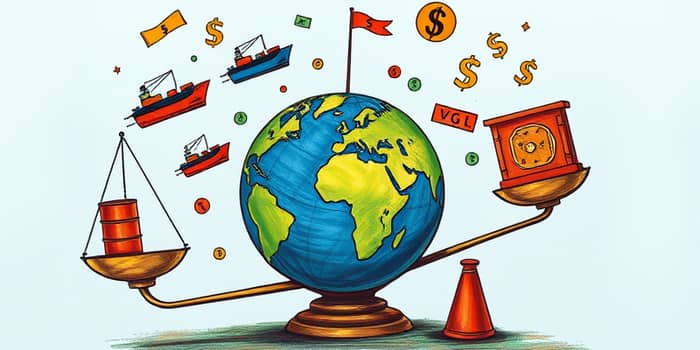
Across the modern global economy, the tension between nations running large surpluses and those facing persistent deficits shapes growth, financial stability, and geopolitical influence. Understanding the forces behind these persistent trade imbalances offers insight into how countries borrow, lend, and respond to shifting economic tides.
Understanding the Conceptual Framework
At the heart of global imbalances lies the balance of trade, the simple difference between a nation’s exports and imports of goods and services. When exports exceed imports, a trade surplus emerges; the reverse generates a trade deficit. However, the balance of trade tells only part of the story.
The current account provides a broader lens, encompassing trade in goods and services, primary income (investment returns and wages abroad), and secondary income (remittances and transfers). Economists focus on current account positions to gauge each country’s net financial relationship with the world.
Underpinning these measures is the savings–investment identity, which asserts that the current account equals national saving minus domestic investment. A current account deficit means a country invests more than it saves and must borrow from abroad; a surplus indicates saving outpaces investment, allowing the country to lend internationally.
Historical Evolution: From Modest Gaps to Major Imbalances
Global imbalances have evolved dramatically since the 1970s. From the mid-1970s to the mid-1990s, total surpluses and deficits hovered around 2–3% of world GDP, reflecting broadly balanced trade and capital flows.
Between 2000 and 2007, imbalances surged above 4% of world output. China’s entry into the World Trade Organization in 2001, coupled with export-led growth, fueled massive surpluses. Germany, Japan, and major oil exporters also accumulated wealth, while the United States, United Kingdom, and parts of southern Europe piled up deficits.
- Asian central banks accumulated large dollar reserves, keeping currencies competitive.
- Rapid U.S. consumption growth and a housing boom amplified deficits.
- The Council on Foreign Relations Index peaked just as the 2008 financial crisis began.
After the global financial crisis, imbalances receded but remained above pre-2000 norms. Lower oil prices, China’s rebalancing toward consumption, and deleveraging in deficit economies helped narrow the gaps.
In the late 2010s and early 2020s, imbalances resurfaced. The United States remained a major net debtor, while China, Germany, and Japan held large surpluses. The COVID-19 pandemic and Russia’s invasion of Ukraine in 2022 triggered commodity shocks and supply-chain disruptions, pushing imbalances higher again.
Major Players: Surplus and Deficit Countries
Roughly 60 nations run goods trade surpluses, led by industrial exporters and commodity producers. Meanwhile, advanced economies with high consumption and investment needs often post deficits.
These positions influence exchange rates, capital flows, and domestic financial conditions. Large deficits can expose countries to sudden reversals in capital, while surpluses may fuel asset bubbles abroad.
Deep Causes of Global Imbalances
While tariffs and trade barriers capture headlines, economists attribute imbalances primarily to domestic macro conditions. Fiscal, saving, and investment choices shape each nation’s external position.
- Fiscal policy: large government deficits lower public saving and widen current account gaps.
- Private saving behavior: low household saving in deficit countries versus high corporate and household saving in surplus nations.
- Investment rates: economies investing heavily in infrastructure and housing may import capital and run deficits.
- Exchange rate and reserve management: official asset purchases can sustain undervalued currencies.
Structural factors also matter. Aging populations in advanced economies often save more, generating surpluses. Emerging markets with rapid growth attract capital to finance imports of technology and equipment, resulting in deficits.
Why It Matters: Risks and Policy Insights
Widening imbalances can precipitate financial crises or abrupt capital-flow reversals, as history demonstrates. Countries with deficits above 3% of GDP face vulnerability to sudden stops, while surplus economies may endure slower domestic demand and overreliance on external markets.
- Promote balanced fiscal stances to align public saving and investment.
- Encourage household saving through improved social safety nets.
- Support structural reforms to diversify economic activity and reduce external dependency.
- Coordinate international policy responses to ensure stable exchange rates and capital flows.
Practical steps include boosting domestic demand in surplus economies and encouraging prudent investment in deficit regions. Open dialogue among central banks, finance ministries, and international organizations can foster coordinated international policy responses that mitigate extreme imbalances.
Conclusion
Global imbalances reflect deep-seated choices about saving, investment, and policy priorities. By recognizing the structural economic differences that drive surpluses and deficits, policymakers can pursue more inclusive, stable growth. Effective cooperation and targeted reforms offer a pathway to narrowing the gaps and enhancing resilience in an interconnected world.
References
- https://www.tradingview.com/chart/GOOGL/bqqflW1z-Global-Trade-Imbalance-Causes-and-Consequences/
- https://engelsbergideas.com/notebook/trade-imbalances-are-stalking-the-global-order/
- https://poole.ncsu.edu/thought-leadership/article/eliminating-global-trade-and-asset-imbalances-without-tariffs/
- https://www.piie.com/blogs/trade-and-investment-policy-watch/we-know-what-causes-trade-deficits
- https://conversableeconomist.com/2026/04/30/global-trade-imbalances-actual-problems-unlikely-solutions/
- https://tax.thomsonreuters.com/en/insights/infographics/6-factors-contributing-to-global-trade-complexity
- https://www.cfr.org/articles/global-imbalances-tracker
- https://www.imf.org/en/blogs/articles/2026/04/06/global-imbalances-old-questions-new-answers
- https://www.wita.org/ustrade/us-trade-trends/the-us-trade-deficit/
- https://www.bea.gov/data/intl-trade-investment/international-trade-goods-and-services
- https://en.wikipedia.org/wiki/Balance_of_trade
- https://cepr.org/voxeu/columns/tariffs-global-imbalances-and-dollar