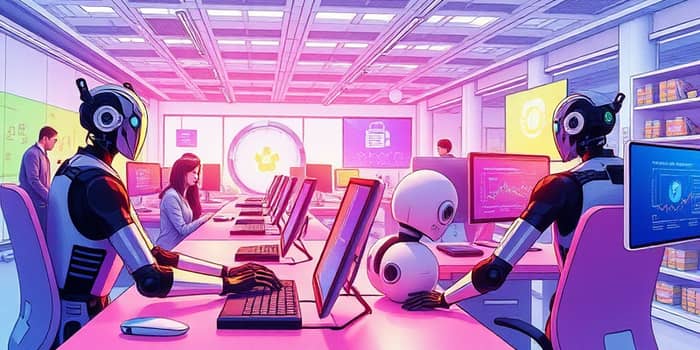
The landscape of work is undergoing a dramatic shift as automation and artificial intelligence redefine how tasks are performed, how jobs evolve, and how economies grow. Far from a simplistic narrative of machines taking over, the real story centers on task reallocation, productivity gains, skill shifts, and institutional adaptation.
The Scale of AI-Driven Disruption
Recent forecasts present a mixed picture of disruption and creation. Goldman Sachs warns that up to 300 million jobs globally are exposed to automation, with 25% of U.S. work hours potentially automated. At the same time, the World Economic Forum predicts 69 million new roles by 2027, and other studies estimate 23 million AI-related positions by 2030.
These figures underscore a fundamental truth: automation acts at the task level first, reshaping roles before eliminating them outright. Historical data from MIT Sloan shows that removing routine duties from bookkeeping led to a 40% rise in real wages despite a one-third decline in headcount.
How Tasks and Jobs Evolve
Technology seldom obliterates entire occupations at once. Instead, it strips away repetitive or rules-based duties, forcing workers to pivot to higher-value activities like judgment, relationship management, and creative problem-solving.
- Substitute effects: Automation of data-heavy or manual routines.
- Complement effects: AI support that amplifies human decision-making.
In sectors such as customer support, simple inquiry handling is increasingly automated, leaving representatives to tackle complex or sensitive issues. In manufacturing, robots perform repetitive assembly, while skilled technicians oversee maintenance and quality control.
Wages and Skills in Transition
The impact on wages is far from uniform. When automation removes simple tasks, remaining work often commands a premium. Yet if expert-level activities are automated, barriers to entry fall and wage pressure rises.
Data from Stanford HAI shows that while taxi-driver employment surged 249% between 2000 and 2020 due to ride-sharing platforms, average earnings stagnated. Meanwhile, occupations that shed routine tasks saw real wage growth, illustrating how uneven effects can reward or penalize different workers.
- 30% of U.S. jobs could be automated by 2030.
- 60% of roles will have tasks significantly modified by AI.
- 50–55% of U.S. jobs reshaped in the next 2–3 years.
As routine duties migrate to machines, demand rises for advanced digital literacy, critical thinking, and adaptive problem-solving. Employers now expect nearly 40% of key skills to change by 2030, with a premium on data, coding, and machine-learning know-how.
New Roles in the AI Economy
Automation destroys some tasks but simultaneously gives rise to novel occupations. These roles span technical development, ethical oversight, infrastructure, and human-centered design.
- AI architect and machine learning engineer
- Data scientist and NLP specialist
- Prompt engineer and AI ethicist
- Robotics technician and AI maintenance support
- Data center operations and power infrastructure jobs
Goldman Sachs highlights that higher incomes and new consumer patterns will spur indirect demand across sectors, further expanding employment opportunities tied to AI.
Policy and Institutional Adaptation
Economic transformation hinges on more than technology: it demands forward-looking policy and corporate governance. To convert disruption into prosperity, stakeholders must collaborate on several fronts.
- Upskilling and lifelong learning programs to bridge skill gaps
- Agile training systems that evolve alongside new technologies
- Ethical oversight frameworks ensuring fairness and transparency
- Labor-market policies that spread productivity gains widely
- Infrastructure investments in power, chips, and data centers
By redesigning roles around human-machine complementarity, organizations can create more meaningful work and boost safety and satisfaction.
Embracing an Uneven Transformation
No sector is immune. White-collar professions in law, finance, and research now face automation pressure once thought exclusive to manual labor. Conversely, roles demanding emotional intelligence, creativity, and hands-on dexterity — from therapists to artisans — exhibit greater resilience.
Recognizing this uneven impact is crucial. It allows individuals to pursue careers less prone to automation, and policymakers to tailor support where it is needed most.
Ultimately, the story of the future of work is one of adaptation rather than defeat. As AI and automation reshape tasks, wages, and skills, those who invest in continuous learning and embrace human-centered design stand to thrive.
By fostering collaboration between governments, educators, and industry, we can harness technological advances for broad prosperity. The coming decade offers an opportunity to elevate work, redefine purpose, and unlock potential across societies.
Embracing automation as augmentation rather than replacement will be the defining challenge — and reward — of our era.
References
- https://www.aspen.edu/altitude/the-future-of-work-how-ai-and-automation-are-changing-business/
- https://set.kellyservices.us/resource-center/business-resources/it/automation-technology-talent/
- https://dsautomation.com/dsa-blog/the-future-of-work-how-ai-robotics-will-reshape-labor-productivity
- https://onlinedegrees.sandiego.edu/ai-impact-on-job-market/
- https://mitsloan.mit.edu/ideas-made-to-matter/a-new-look-how-automation-changes-value-labor
- https://www.goldmansachs.com/insights/articles/how-will-ai-affect-the-us-labor-market
- https://www.commerce.nc.gov/news/the-lead-feed/generative-ai-and-future-work
- https://www.nu.edu/blog/ai-job-statistics/
- https://www.oecd.org/en/topics/policy-issues/future-of-work.html
- https://hai.stanford.edu/news/assessing-the-real-impact-of-automation-on-jobs
- https://unric.org/en/ai-and-the-future-of-work-disruptions-and-opportunitie/
- https://www.bcg.com/publications/2026/ai-will-reshape-more-jobs-than-it-replaces
- https://www.ibm.com/think/insights/ai-and-the-future-of-work