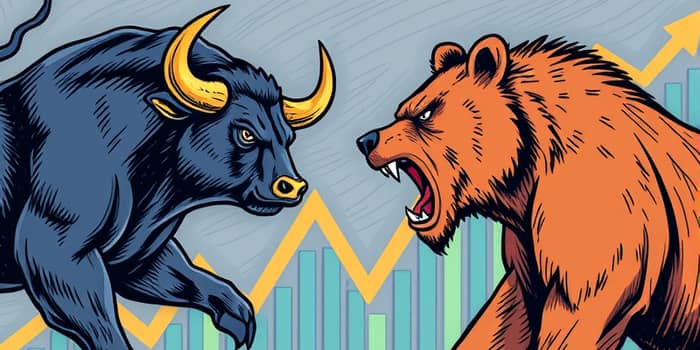
In the financial markets, two dominant themes capture the collective mood of investors: bulls charging ahead in optimism and bears retreating in caution. Understanding how these forces shape market sentiment can be the difference between seizing opportunity and capitulating in fear.
Definitions and Mechanics of Bull vs. Bear Markets
A bull market represents a sustained period of rising prices across major indices. As a guideline, a rise of 20% or more from a recent low signals the onset of a bullish phase. These environments often coincide with economic expansion and GDP growth, supported by corporate revenue gains and robust consumer spending.
Conversely, a bear market is marked by a decline of at least 20% from a recent high, reflecting pervasive pessimism. Falling demand, sluggish earnings, and higher unemployment and labor challenges often accompany these downturns, leading to elevated volatility and risk aversion.
While both terms revolve around price movements, bulls and bears are not merely mirror images. Since 1872, U.S. stocks have experienced 26 bull markets and 26 bear markets, with bulls lasting on average 42 months and bears about 19 months. Long-term upward bias explains why bull runs tend to outlast declines, but bears can be sharper and more intense.
It’s important to remember that the 20% threshold is a guideline rather than a hard rule. Individual sectors or asset classes may experience bull or bear runs even if the broad market does not. According to J.P. Morgan, levels must be sustained over weeks or months, and one-off moves often reverse quickly, especially in volatile environments.
Analysts also note the role of valuation metrics and momentum indicators in confirming market phases. Price-to-earnings ratios, market breadth, and moving average crossovers often align with investor sentiment, reinforcing the prevailing trend.
What Drives Market Sentiment?
Market sentiment is the prevailing attitude or mood among investors, shaping supply and demand regardless of underlying fundamentals. It captures the collective emotional state of participants and drives short-term price swings.
- Major news events: geopolitical crises, policy shifts, or corporate scandals
- Economic releases: GDP, inflation, unemployment, and consumer confidence
- Earnings results: quarterly reports and forward guidance
- Central bank actions: interest rate changes and liquidity policies
- Media narratives and social platforms: rapid spread of optimism or fear
Within risk-on regimes, investors embrace growth stocks, corporate credit, and emerging markets. The U.S. dollar may weaken as capital chases higher yields abroad. Conversely, risk-off periods see a surge into safe havens like government bonds, gold, and defensive sector equities, reflecting a collective flight to stability.
Quantitative and Qualitative Sentiment Indicators
To gauge whether bulls or bears are dominating, investors turn to both numeric gauges and behavioral measures. These indicators offer insights into market psychology before price moves become obvious.
- CBOE Volatility Index (VIX): Known as the fear gauge, a rising VIX signals heightened fear and risk aversion, while low VIX levels indicate complacency.
- Put/Call Ratio: Tracks the volume of puts versus calls. Elevated ratios imply hedging and bearish bias; low ratios suggest speculative bullishness.
- 52-Week High/Low Metrics: Comparing stocks hitting new highs against those at year-long lows reveals broad market strength or weakness.
Combining multiple indicators often yields clearer signals. For instance, a simultaneous spike in the VIX and a jump in the put/call ratio can confirm deteriorating sentiment, alerting traders to scale back risk. Similarly, a surge in new 52-week highs across sectors tends to precede sustained rallies, offering a window for tactical entry.
Qualitative gauges such as investor surveys by the American Association of Individual Investors (AAII) add context. When bullish readings exceed historical averages, caution may be warranted; when bearish readings spike, contrarian buyers often find their best opportunities.
Historical Behavior, Investor Psychology, and Practical Implications
Behavioral neuroscience shows that fear and greed are powerful forces. In a bull run, euphoria and herd behavior can push valuations to extremes, tempting investors to chase returns at peak prices. In contrast, during bear markets, panic selling often leads to forced liquidations and missed rebounds.
Since the 1920s, every major sell-off eventually gave way to new highs, underscoring a resilient upward bias. Yet timing these reversals is notoriously difficult. By observing sentiment indicators and economic signals, you can position yourself to benefit from the next turn in the cycle.
- Keep a long-term perspective: historical data favors patient investors.
- Use sentiment extremes as contrarian clues: extreme fear can signal buying opportunities, while extreme greed warns of topping risks.
- Diversify across asset classes: balance equities with bonds, commodities, or defensive sectors to smooth volatility.
- Review regular indicators: track VIX spikes, put/call surges, and fund-flow reports to detect mood shifts.
- Maintain discipline: avoid emotional trading by setting clear rules for entries and exits.
Looking back, the dot-com bubble of 2000 exemplified unchecked bullish sentiment, as valuations soared into the stratosphere before collapsing. In stark contrast, the 2008 financial crisis saw bearish panic that drove the VIX above eighty and forced many to abandon equities at the bottom. Yet investors who held or gradually redeployed capital captured the robust bull market that followed.
Today, digital platforms amplify sentiment swings as social media accelerates herd behavior. Viral narratives can trigger rapid rotations between risk-on and risk-off, demanding that investors stay vigilant and adapt strategies in real time.
As markets evolve, new tools harness alternative data—such as sentiment analysis of news feeds, social media chatter, and even satellite imagery—to measure mood in real time. Blending these innovations with traditional indicators enhances foresight, enabling investors to anticipate turning points before they are fully reflected in price.
Ultimately, mastering bull and bear dynamics is about marrying objective analysis with emotional awareness. By remaining disciplined, diversified, and informed, you can navigate any market cycle and harness the full potential of your investments.
References
- https://www.fidelity.com/learning-center/smart-money/bear-vs-bull-market
- https://realtrading.com/trading-blog/market-sentiment-indicators-day-trading/
- https://ycharts.com/indicators/us_investor_sentiment_bull_bear_spread
- https://www.stockgeist.ai/market-sentiment-indicators/
- https://www.citizensbank.com/learning/bull-market-vs-bear-market.aspx
- https://www.ig.com/en/trading-strategies/what-is-market-sentiment-and-how-do-you-trade-it--180420
- https://www.nerdwallet.com/investing/learn/bullish-vs-bearish
- https://www.semantic-visions.com/insights/what-are-market-sentiment-indicators-and-why-do-they-matter
- https://www.youtube.com/watch?v=aewFn8E5Vm4
- https://www.sumgrowth.com/InfoPages/Market-Sentiment.aspx
- https://www.schwab.com/learn/story/bull-vs-bear-understanding-market-phases
- https://www.sentimentrader.com
- https://en.macromicro.me/collections/34/us-stock-relative
- https://www.sofi.com/learn/content/understanding-market-sentiment/
- https://8figures.com/blog/portfolio-allocations/how-to-read-market-sentiment-indicators-signals-and-portfolio-moves