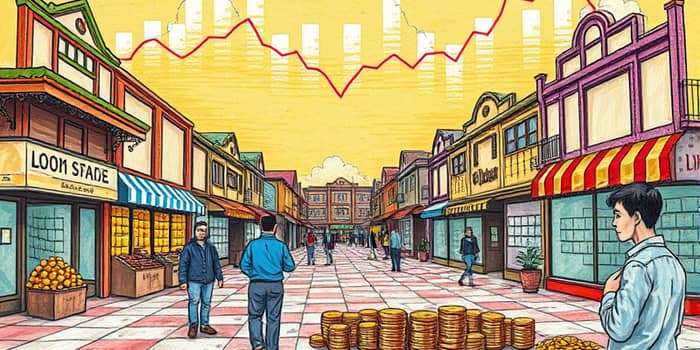
In moments of uncertainty, households tighten their belts, believing that saving more will protect their future. Yet, when an entire economy embraces this mindset, a surprising reversal occurs: what seems prudent for one can become perilous for all. This tension sits at the heart of the paradox of thrift, a Keynesian insight revealing that collective frugality may undermine the very security it seeks to build.
Understanding the Core Concept
The paradox of thrift illustrates the classic fallacy of composition in economics: actions that benefit an individual can harm the group. When every household raises its savings rate, total consumption falls. Because one person’s spending directly becomes another’s income, the economy contracts and aggregate saving may not rise.
Individually, setting aside funds offers a cushion against unexpected events. Collectively, however, this surge in saving triggers firms to cut back on production, layoffs rise, and income declines—a cycle that can deepen a downturn.
- Individual thrift builds personal security.
- Widespread saving pulls money out of circulation.
- Reduced spending shrinks output and employment.
The Keynesian Mechanism in Action
John Maynard Keynes first described this dynamic in 1936. He argued that recessions stem more from falls in demand than from supply shortages. By boosting the marginal propensity to save (MPS), households lower their marginal propensity to consume (MPC), and total demand drops.
- Households choose to save a higher fraction of income.
- Firms face falling revenues and unwanted inventory.
- Producers cut jobs and output, reducing overall income.
As incomes shrink, the actual amount people can save falls, producing a reverse multiplier effect that can leave total savings unchanged or lower than before, all while leaving people feeling financially insecure.
Lessons from History and Empirical Evidence
During the Great Depression, chronic underemployment and low demand provided fertile ground for the paradox of thrift. Keynes’s warnings sprang from the reality that U.S. households were hoarding cash while factories stood idle.
Modern studies echo his insight. Research on post-2008 household deleveraging shows that when debt-conscious families increase saving, consumption plummets, prolonging sluggish growth. Conversely, economies with moderate saving and robust spending often recover more quickly from shocks.
Modern Debates: When Is Saving Too Little?
While Keynesians warn against excessive thrift in downturns, some neoclassical economists fret about the opposite: insufficient savings harming long-run growth. They argue that savings finance investment in infrastructure, innovation, and human capital.
A Cato Institute analysis highlights declining U.S. saving rates and suggests that deficits and easy credit have fueled consumption today at the expense of tomorrow’s prosperity. The tension between short-term demand management and long-term capital formation remains central to policy debates.
Policy Responses: Easing the Vicious Cycle
When private thrift drags down demand, Keynesians advocate that the government acts as spender of last resort. By stepping in to maintain spending levels, the public sector can sustain income and employment until private confidence returns.
- Fiscal stimulus: public works, transfers, and tax cuts.
- Monetary easing: lower interest rates to encourage borrowing.
- “Spend now, tax later” to prevent immediate austerity.
Such interventions can break the feedback loop of saving and contraction, enabling households to rebuild confidence before resuming normal saving habits.
Criticisms and Alternative Views
Critics of the paradox of thrift emphasize that saving eventually funds investment. Lower interest rates can redirect excess savings into capital projects, supporting growth without immediate demand stimulus.
Others point out that cultural factors, demographics, and structural shifts shape saving preferences more than cyclical trends. In aging societies, higher saving may reflect long-term needs rather than short-run caution.
The truth may lie in balance: recognizing that slumps call for collective action to preserve demand, while surplus resources in growth phases should fund productive investment.
Balancing Thrift and Spending for Sustainable Prosperity
The paradox of thrift challenges us to view our financial choices as part of a larger tapestry. While prudent saving protects families, uncoordinated belt-tightening can imperil entire communities.
Striking the right equilibrium means:
1. Maintaining a baseline of personal reserves;
2. Supporting collective spending during slowdowns;
3. Encouraging productive investment when growth returns.
By weaving together individual prudence and shared responsibility, societies can navigate uncertainty without sacrificing long-term dynamism. The paradox of thrift reminds us that true prosperity depends not only on what we save, but on what we spend together to build a resilient future.
References
- https://www.scribd.com/document/383375909/Paradox-to-Thrift
- https://www.youtube.com/watch?v=q7uUwUx81iE
- https://www.economicsonline.co.uk/all/paradox-of-thrift.html/
- https://en.wikipedia.org/wiki/Paradox_of_thrift
- https://testbook.com/question-answer/what-is-the-concept-of-the-paradox-of-thrift--696784fd3935a0e535f6c3c2
- https://www.pmfias.com/paradox-of-thrift/
- https://www.stlouisfed.org/publications/page-one-economics/2012/05/01/wait-is-saving-good-or-bad-the-paradox-of-thrift
- https://econ.economicshelp.org/2007/02/keyness-paradox-of-thrift.html
- https://www.youtube.com/watch?v=l5BeKCbXngI
- https://www.britannica.com/video/thrift-paradox-Keynesian-economics/-206682
- https://www.youtube.com/watch?v=qKSP_pB4MhI