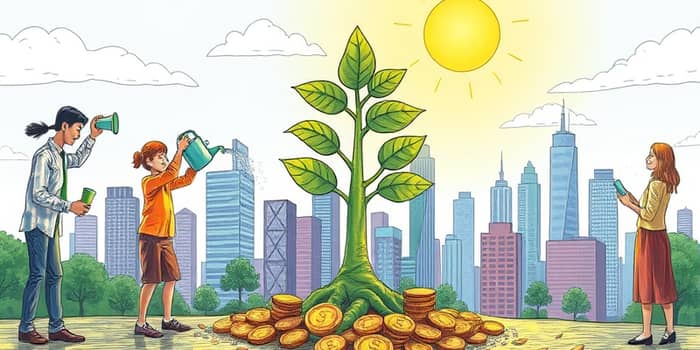
Across the globe, capital is being mobilized to tackle environmental and social challenges. Financial institutions, policymakers, and investors are now redefining success by aligning returns with real-world impact.
Definitions and Core Concepts
Sustainable finance, dubbed the re-wiring of the financial system, integrates environmental, social, and governance considerations into banking, insurance, asset management, and capital markets decisions.
Its objective is to support reductions in climate risk, mitigate the impact of extreme weather events, and guide capital toward a low-carbon, climate-resilient, inclusive economy while still delivering financial returns.
- Green finance focuses primarily on environmental outcomes such as greenhouse gas mitigation and adaptation projects.
- Sustainable finance is broader and addresses social and governance issues alongside environmental goals, including labor standards and corporate transparency.
Key sub-markets include sustainable lending—green loans, sustainability-linked loans, social loans, transition finance—and sustainable investing via ESG-integrated funds, bonds, and impact vehicles.
Market Size, Growth and Outlook
From niche roots, the global sustainable finance market has surged to an estimated US$7.95 trillion in 2025, and is projected to reach US$42.68 trillion by 2035 at a compound annual growth rate of 18.9%.
This dramatic rise illustrates how investors and institutions are embracing new metrics of success beyond pure profit, channeling resources into lasting climate solutions.
- Energy security and affordability concerns shaping long-term transition strategies.
- Rising costs of physical climate risks driving demand for resilient assets.
- Increasing focus on adaptation and resilience alongside mitigation efforts.
- Digital infrastructure and AI-driven demand influencing sustainable bond issuance.
In 2025, sustainable debt issuance—combining bonds and loans—totaled just under US$1.6 trillion, down modestly from US$1.7 trillion in 2024, demonstrating resilience amid regulatory recalibration and political headwinds.
Sustainable Lending: Instruments, Standards, and Use Cases
Sustainable lending encompasses instruments that fund green, social, or transition projects and loans with performance-based incentives.
Green loans allocate 100% of proceeds to projects with measurable environmental benefits, from renewable energy installations to clean transport initiatives.
- Use of proceeds must be clearly defined and aligned with recognized environmental objectives.
- Evaluation and selection processes disclosed to ensure alignment with sustainability criteria.
- Management of proceeds tracked separately to guarantee funds are used as intended.
- Reporting with qualitative and quantitative indicators to demonstrate real-world impact.
Developing markets currently hold only a fraction of global green loans—roughly US$1.6 billion of an estimated US$33 billion—highlighting a sizable growth opportunity in developing countries.
Sustainability-linked loans adjust pricing based on borrower-level performance targets, such as emissions intensity or diversity metrics. They represented 72% of sustainable loan volume in 2024 but saw a decline in 2025 as issuers faced an investor and regulatory pushback against greenwashing.
This shift signals a market moving from volume to quality in lending, demanding stronger targets and transparent reporting.
Sustainable Investing: Bonds and Equity Strategies
Sustainable investors choose instruments that embed ESG considerations or deliver direct impact. Green, social, sustainability, and transition bonds remain core, alongside sustainability-linked bonds that tie coupon rates to performance milestones.
Equity strategies now integrate ESG scoring and active engagement to influence corporate behavior, while impact funds target measurable social outcomes, from affordable housing to access to clean water.
Despite a modest dip in issuance, Moody’s expects global sustainable bond volumes to remain broadly stable in 2026, underscoring steady appetite for purpose-driven capital.
Risk Management, Policy and Regulation
Robust policy frameworks and guidelines are essential to guard against greenwashing and maintain market integrity. International standards such as the Green Bond Principles and the Sustainable Finance Disclosure Regulation set baseline requirements.
Regulators worldwide are enhancing disclosure rules, stress-testing against physical climate risks, and promoting greater transparency and accountability in reporting to build investor confidence.
Future Outlook and Call to Action
As the ecosystem evolves, technology, data analytics, and innovative structures will deepen impact measurement and unlock new capital pools.
Financial professionals, corporations, and policymakers all play a role: by adopting stringent criteria, embedding sustainability in core strategy, and fostering collaborative platforms, they can shape a financial system that delivers prosperity together with planetary health.
Ultimately, sustainable finance offers a path to reconcile profit with purpose, steering capital toward solutions that benefit people, communities, and the planet.
References
- https://www.moodys.com/web/en/us/insights/credit-risk/outlooks/global-sustainable-finance.html
- https://www.bbvacib.com/green-and-sustainability-linked-loan-newsletter/
- https://www.tdsecurities.com/ca/en/sustainable-finance-2025-in-review-and-2026-outlook
- https://www.centralbank.ie/statistics/statistical-publications/behind-the-data/surveying-the-green-lending-landscape-to-households-and-non-financial-corporations
- https://www.youtube.com/watch?v=jrgDZ6Qy09s
- https://www.worldbank.org/en/news/feature/2021/10/04/what-you-need-to-know-about-green-loans
- https://events.sustainablefitch.com/sustainablefinanceoutlook2026
- https://www.climatepolicyinitiative.org/publication/the-state-of-green-banks-2025-learnings-from-green-financing-structures-around-the-world/
- https://www.interfima.org/esg-and-sustainable-finance-2026
- https://www.imf.org/en/topics/climate-change/green-finance
- https://www.wri.org/technical-perspectives/6-opportunities-sustainable-finance-2026
- https://www.greenfinanceplatform.org/policies-and-regulations/green-loan-statistics-0
- https://www.spglobal.com/sustainable1/en/insights/2026-sustainability-trends
- https://www.statista.com/topics/9069/green-banking/
- https://www.precedenceresearch.com/sustainable-finance-market