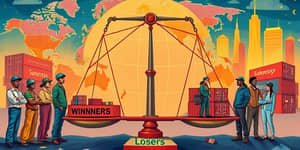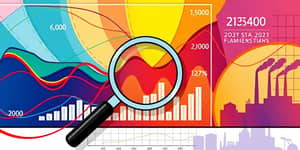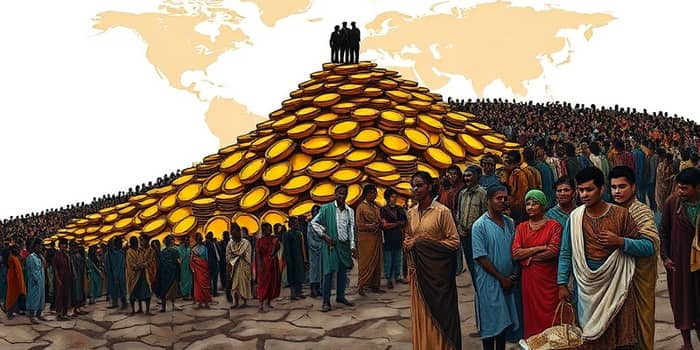
Global economic headlines often trumpet poverty reduction and rapid growth in emerging markets, but beneath those numbers lies an unsettling reality. While some nations have closed gaps in average incomes, the gulf between the richest and the poorest individuals has never been wider. This article explores the complex patterns of convergence between countries and divergence within them, the unprecedented concentration of wealth at the top, and the urgent policy interventions needed to restore fairness and stability.
What Global Inequality Looks Like Today
In 2023, the richest one percent of individuals owned nearly 47.5 percent of all global wealth, equivalent to 214 trillion dollars. By contrast, adults with less than 10000 dollars to their name represent almost 40 percent of humanity yet hold less than one percent of global assets. A mere 56000 people in the top 0.001 percent control three times more wealth than the bottom half of the world’s population combined.
Income inequality mirrors these imbalances. In 2025, the richest one percent captured 20.3 percent of global income, up from around 16.9 percent in 1980. Of the 57 countries with reliable data between 1990 and 2015, 46 saw the top one percent increase their share of national income. Around 720 million people still live in extreme poverty, a stark reminder that economic progress has not reached everyone.
The Historical Trends and Paradox of Convergence and Divergence
Global inequality is rarely a straight trajectory. Between‐country disparities have shrunk as economies like China and India surged forward, lifting billions out of poverty. Yet within many nations, especially advanced economies, inequality has ballooned. In 1980, differences across countries accounted for under half of total inequality; by 2020, within‐country gaps made up two-thirds of the global sum.
This paradox highlights that average improvements at national level can hide deep social fissures. In sub-Saharan Africa, average incomes remain low and child public spending averages only two hundred euros per year, compared to nine thousand euros in the global North. The result is persistent inequalities of opportunity within and between nations.
Drivers of Rising Within‐Country Inequality
- Globalization and trade shifts favoring capital over labor
- Rapid technological advances concentrating returns in tech sectors
- Weakening labor bargaining power and union representation
- Tax policies that underweight capital gains and inheritances
- Consolidation of markets and growing corporate monopolies
These factors have combined since the 1980s to reshape income and wealth distribution. Financial globalization enabled high earners to access offshore structures and tax havens, while corporate consolidation augmented profit shares going to shareholders. Meanwhile, wage growth for middle and lower‐income workers has lagged behind productivity gains in many advanced economies, fueling frustration and social unrest.
Inequality Across regions
The United States exemplifies extremes among rich nations, with the top one percent owning over 40 percent of national wealth, a share that has climbed for decades. In China and India, impressive growth lifted hundreds of millions out of poverty but also gave rise to new billionaires and widened urban‐rural divides. Russia saw its wealthiest families accumulate vast fortunes even as public services faltered.
Latin America and the Middle East have long battled high inequality, rooted in land and resource concentration. Sub-Saharan Africa faces both high inequality and entrenched poverty, where a lack of infrastructure, political instability, and limited public spending constrain opportunity. These regional patterns reveal that rising prosperity does not automatically translate into shared progress.
Inequality Beyond Income: Emissions, Opportunity, and Access
Monetary measures capture only part of the picture. Inequality also appears in carbon footprints, education, health outcomes, and digital connectivity. The richest ten percent account for 47 percent of emissions tied to consumption, and when considering private capital ownership that share jumps to 77 percent. This is an extreme concentration of emissions and wealth that amplifies climate injustice.
- Unequal access to quality healthcare and education
- Gender gaps in earnings and political representation
- Digital divides limiting opportunities for remote learning
- Disparities in infrastructure and public services
- Systemic biases based on ethnicity, origin, and disability
Such multidimensional inequality erodes social cohesion and deepens grievances, stressing democracies and fueling conflict over resources and representation.
Consequences and Policy Pathways Forward
High and persistent inequality carries heavy costs. It undermines trust in institutions, fosters political polarization, and encourages populist movements on both left and right. Research links unequal societies to weaker social mobility, higher crime rates, and reduced life expectancy. When left unchecked, these tensions can spill over into geopolitical instability and environmental tragedies.
- Progressive income taxation to rebalance shares
- Wealth taxes on large fortunes and estates
- Global fiscal coordination to curb tax avoidance
- Universal public services in health, education, and housing
- Strong social safety nets and unemployment insurance
Ultimately, closing the gap is a political choice, not an inevitability. With concerted action—resilient policy frameworks, international cooperation, and civic engagement—societies can forge a more equitable future. The challenge is immense, but so is the collective potential to reshape economies for the many, rather than the few.
Today’s debate on inequality must move beyond abstract numbers to a shared vision of fairness. By recognizing multidimensional gaps, amplifying voices of the marginalized, and embracing reforms that redistribute power and resources, we can begin to narrow the chasm. The world stands at a crossroads: one path leads to deepening divides, the other to inclusive growth and sustained stability. The choice is ours.
References
- https://wid.world/news-article/world-inequality-report-2026-inequality-persist-at-a-very-extreme-level/
- https://www.brookings.edu/articles/rising-inequality-a-major-issue-of-our-time/
- https://inequality.org/facts/global-inequality/
- https://www.un.org/en/un75/inequality-bridging-divide
- https://www.youtube.com/watch?v=R67u5U5c5RM
- https://www.oxfamamerica.org/explore/issues/economic-justice/income-and-wealth-inequality/
- https://www.brookings.edu/articles/the-present-and-future-of-global-inequality/
- https://wealthproject.gc.cuny.edu/data/data-sources-library/inequality-trends/
- https://www.oxfam.org.uk/get-involved/campaign-with-oxfam/fight-inequality/oxfams-global-inequality-report/
- https://apps.urban.org/features/wealth-inequality-charts/
- https://ourworldindata.org/economic-inequality
- https://wir2026.wid.world
- https://inequalitylab.world/en/
- https://wid.world