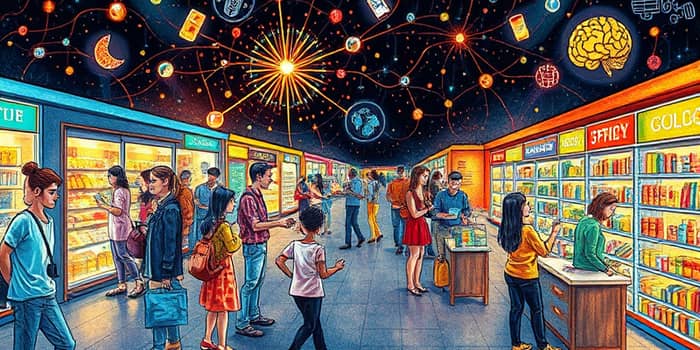
Understanding why people buy is essential for any organization aiming to meet evolving needs and capture market share. By select, purchase, use, and dispose of offerings, consumers shape every market’s demand curve. This article decodes the intricate web of influences that drive buying decisions, translates behavior into demand signals, highlights 2024–2026 trends, and shows how firms leverage data and AI to respond effectively.
Defining Consumer Behavior
At its core, consumer behavior examines how individuals, groups, or organizations recognize needs, search for information, evaluate alternatives, make purchase decisions, and engage in post-purchase actions. It draws on psychology, economics, sociology, and biology to explain decision processes and actual actions that lead to consumption.
The link to demand is direct: aggregate consumer behavior is what forms market-level demand curves, showing the relationship between price, perceived value, and quantity purchased. By understanding this, companies can forecast volume, optimize pricing, and tailor offerings.
Four Types of Buying Behavior
Not all purchases are equal. Consumers exhibit distinct patterns depending on involvement and brand differences. These patterns influence how stable or volatile demand can be in a category.
Key Drivers Shaping Decisions
Multiple factors converge to influence a buyer’s journey and ultimately drive demand. Breaking them down helps companies pinpoint where to intervene.
Psychological Factors
Perception determines how consumers interpret advertising, packaging, and reviews. Because of selective attention, the same message can produce different demand responses across segments.
Motivation arises from unmet needs—physiological, safety, social, esteem, and self-actualization. As aspirations evolve, demand shifts from basics to products expressing identity and purpose.
Learning from past experiences builds brand loyalty or prompts switching, affecting repeat purchase rates and long-term demand patterns.
Personal and Social Influences
Age, life stage, occupation, and income level shape purchasing power and category mix. For example, retirees spend more on healthcare, while young families prioritize childcare and education.
Family roles, peer groups, and cultural norms act as reference points. psychological motives, social influence, and constraints guide choices and create social proof that can accelerate or dampen demand.
Economic, Situational, and Technological Contexts
In times of inflation or uncertainty, consumers adopt value-conscious spending habits and choices, driving growth in private labels and club-store brands.
Situational factors—seasonality, store environment, time pressure—can prompt impulse buys or planned purchases in different measure.
Digitalization and ecommerce have transformed discovery and purchase paths. dynamic pricing and AI tools empower real-time personalization, influencing both conversion and average order value.
Translating Behavior into Market Demand
The Engel–Kollat–Blackwell model outlines the stages where firms can shape demand: from need recognition to post-purchase evaluation. At each stage, targeted messaging, seamless experiences, and frictionless transactions lift conversion rates and boost volume.
Maslow’s hierarchy explains why demand shifts upward: as basic needs are met, consumers seek esteem and self-actualization products—wellness, education, sustainable goods—which represent high-growth categories today.
2024–2026 Trends
Heightened economic pressures are driving more strategic, value-driven spending. Recent studies find 38% of shoppers have cut back on discretionary purchases, while 39% compare prices more rigorously. There’s a surge in secondhand and private-label adoption as consumers reallocate budgets.
Omnichannel dynamics persist: 67% of shoppers research online but complete purchases in-store, and 60% still rely on physical retail for product discovery—proof that brick-and-mortar remains essential for engagement.
Leveraging Data and AI to Act on Insights
Modern firms harness advanced analytics and AI to turn raw behavior into actionable insights. Predictive models forecast demand spikes, while recommendation engines increase basket size and frequency.
Sentiment analysis and social listening reveal emerging needs, enabling agile product development. Firms are integrating real-time sales data with customer profiles to optimize pricing and inventory dynamically, reducing stockouts and markdowns.
Practical Strategies for Businesses
- Map the full decision journey and identify drop-off points to improve conversion.
- Use micro-segmentation powered by AI to tailor offers and messaging.
- Implement dynamic pricing strategies to capture value and manage demand peaks.
- Invest in omnichannel experiences that blend digital convenience with in-store discovery.
By putting consumer behavior at the heart of strategy, companies can anticipate needs, tailor experiences, and foster loyalty—turning insights into sustained demand growth.
References
- https://blewminds.com/musings/squad-musings/decoding-consumer-behavior-types-elements-models-2/
- https://www.circana.com/post/unpacking-consumer-marketing-trends-that-will-drive-growth-in-2026
- https://www.simon-kucher.com/en/insights/decoding-consumer-shifts-better-growth
- https://www.salsify.com/blog/how-consumer-buying-behavior-is-changing-in-2026
- https://online.longwood.edu/business/mba/marketing/how-consumer-decisions-are-researched/
- https://provokeinsights.com/winter-2026-trends-research/
- https://www.forrester.com/blogs/decoding-patterns-in-consumer-behavior-empowers-leaders/
- https://www.productmarketingalliance.com/what-influences-customer-behavior/
- https://covid.fabriciano.mg.gov.br/official-origin/decoding-consumer-and-market-insights-a-comprehensive-guide-1767648266
- https://www.rasmussen.edu/degrees/business/blog/5-factors-that-influence-consumer-behavior/
- https://bluemonarchgroup.com/whitepaper/decoding-consumer-behavior-insights-and-strategies/
- https://www.clootrack.com/knowledge/customer-behavior-analytics/major-factors-influencing-consumer-behavior
- https://www.netguru.com/blog/consumer-behavior-trends
- https://www.youtube.com/watch?v=Hi_RZzxBfFw