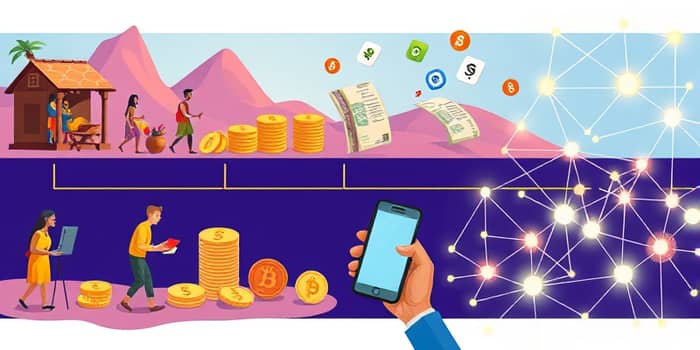
At its core, exchange is a mutual transfer of value that underpins every economy. Throughout history, human societies have moved from direct swapping to sophisticated digital networks, each innovation solving the limits of its predecessor and paving the way for greater connectivity and prosperity.
This article traces the chronological journey of exchange—from prehistoric barter to modern blockchains—highlighting the challenges each system addressed and the legacy it left for the next era.
Barter: The Dawn of Direct Exchange
Barter represents the simplest form of trade: two parties swap goods or services without a common medium. Archeological evidence suggests that around 6000 BC, Mesopotamian communities exchanged grain for tools, animal hides for pottery, and other necessities.
While barter requires no special instrument, it thrives only in tightly knit groups where trust is implicit and goods are limited.
- double coincidence of wants: each party must want what the other offers simultaneously.
- common unit of account: without a shared measure, comparing the value of different items is difficult.
- Storage challenges: perishability of goods makes long-term value retention impossible.
- specialization and trade expansion: barter confines economic roles and restricts long-distance commerce.
Ultimately, these obstacles led societies to seek a universal medium that could streamline trade and record value independently of specific goods.
Commodity Money: Introducing Intrinsic Value
Commodity money emerged when items with intrinsic utility—such as livestock, shells, salt, and metals—became accepted as payment. Domesticated cattle served as wealth units as early as 9000 BC, while cowry shells circulated across Asia, Africa, and Europe by 1300 BC.
- intrinsic value and broad acceptance made items like shells and salt functional as currencies.
- Better store of value than perishable goods.
- Early unit of account enabled basic price comparisons.
Despite these strengths, commodity money was often bulky, hard to transport, and challenging to divide precisely. Variations in quality prompted disputes, demonstrating the need for a more standardized form of money.
Coinage: Standardization and Trust
By around 1000 BC in China, bronze and copper imitations of cowry shells and miniature tools served as proto-coins. In Lydia, around 700 BC, the first precious metal coins—made of electrum—appeared. These coins bore official stamps that guaranteed their weight and purity.
Governments and city-states struck coins in gold, silver, and bronze, creating a uniform medium that facilitated both local and long-distance trade. With standardized weight and purity, coins solved divisibility issues and built public confidence through official markings.
However, coin-based systems remained dependent on metal supplies, suffered from debasement, and were cumbersome for very large transactions—issues that would spur the development of paper money and banking.
Paper Money and Early Banking
China led the shift to paper during the Tang dynasty, issuing merchant receipts around 807 AD that later evolved into government-backed banknotes under the Song and Ming dynasties. These notes represented claims on stored metal rather than possessing intrinsic worth.
In 17th-century Europe, goldsmiths in London stored precious metals and issued deposit receipts that circulated as money. The Bank of England, founded in 1694, formalized this practice, extending state-backed notes that became widely trusted instruments of commerce.
By replacing heavy coin shipments with lightweight paper claims, societies unlocked rapid trade expansion, improved record-keeping, and more flexible credit systems.
From Gold Standard to Fiat Money
The 19th century ushered in the gold standard, as Britain adopted it in 1819 and the United States followed in 1834. Under this regime, national currencies were defined by a fixed quantity of gold, allowing holders to convert paper money into metal on demand.
Although this system maintained price stability and international confidence, its rigid link to gold reserves limited governments’ ability to respond to economic crises. World wars and depressions led many countries to suspend convertibility. By 1971, most major economies had transitioned to fiat money backed by government decree, granting central banks greater policy flexibility.
Electronic and Digital Payments
The late 20th century saw the emergence of credit cards, electronic fund transfers, and online banking. Money evolved from physical notes and coins into digital ledger entries. Consumers could now settle transactions instantly across continents, reshaping global commerce.
This era reduced the costs of handling cash, improved transparency, and paved the way for mobile wallets and instant settlement platforms.
Blockchain and Cryptocurrencies: Programmable Money
In 2008, the publication of Bitcoin’s whitepaper introduced a novel form of digital currency secured by a decentralized ledger called a blockchain. Without central intermediaries, participants verify transactions through cryptographic consensus.
- Decentralized, peer-to-peer transactions without central authority.
- Immutable public ledger ensures tamper-proof records.
- programmable, decentralized, and trustless consensus mechanisms automate value transfer.
- Smart contracts enable complex financial instruments on-chain.
While the technology faces hurdles such as scalability and regulatory debates, it holds the potential to democratize finance, lower barriers to participation, and embed autonomous logic directly into money.
A Unified Progression
Looking Ahead
From the simplicity of barter to the sophistication of blockchains, each monetary innovation addressed the flaws of its predecessors, driving economic integration and empowering individuals. By understanding this lineage, we gain insight into how technologies can reshape value exchange and foster inclusive growth.
Embrace the power of financial innovation by educating yourself about emerging platforms, experimenting responsibly with digital assets, and contributing to a future where exchange is more accessible, transparent, and dynamic.
References
- https://www.scribd.com/document/543733042/Project-1
- https://www.ig.com/en-ch/learn-to-trade/ig-academy/a-beginners-guide-to-forex-trading/the-history-of-forex
- https://www.caixabankresearch.com/en/economics-markets/monetary-policy/barter-cryptocurrency-brief-history-exchange
- https://beyourown.org/key-milestones-in-the-evolution-of-trading/
- https://www.hiro.so/blog/tracing-the-social-narratives-shaping-the-future-of-money-bartering-to-banknotes-to-bitcoin
- https://www.creditkarma.com/money/i/history-of-money
- https://www.accountancysa.org.za/feature-barter-to-blockchain-the-dynamic-evolution-of-payment-technologies/
- https://www.bankofengland.co.uk/explainers/how-has-money-changed-over-time
- https://en.wikipedia.org/wiki/Timeline_of_international_trade
- https://crypto.com/us/university/history-of-money-barter-to-bitcoin
- https://www.money.org/money-museum/history-of-money/
- https://www.uscurrency.gov/history
- https://www.youtube.com/watch?v=n9bttbmfLh0
- https://onlinelibrary.wiley.com/doi/pdf/10.1002/9781119201601.ch4