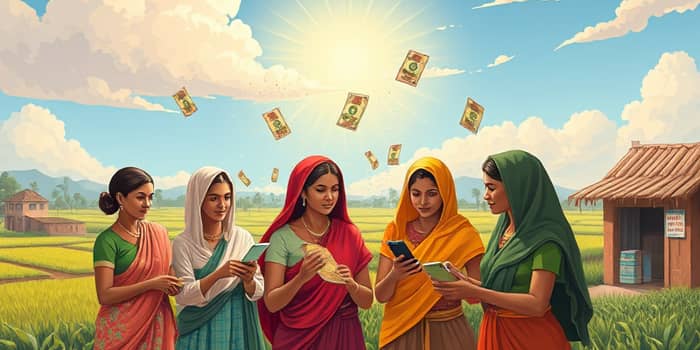
Financial exclusion leaves millions without the tools to build a secure future. Across continents and communities, microfinance has emerged as a transformative force—a true magic wand that can unlock economic potential and foster resilience. This article explores how microfinance empowers the financially excluded, offering practical insights and inspiration for driving inclusion at scale.
Understanding Financial Exclusion
Despite remarkable progress, an estimated 1.3 billion adults remain unbanked worldwide. Among these, over 650 million reside in just eight countries: Bangladesh, China, Egypt, India, Indonesia, Mexico, Nigeria, and Pakistan. Regions such as the Middle East and Africa face exclusion rates near 50%, while South and Central America sit at 38%, Eastern Europe at 33%, and Asia Pacific at 24%.
Women bear the brunt of this gap. In low- and middle-income countries, women are five percentage points less likely than men to own an account. In MENA, only 46% of women have formal accounts—a 14-point gender gap that soars to 30 points in Pakistan and remains above 20 points in Nigeria and Türkiye.
The reasons for being unbanked are both practical and structural. Long distances to branches, stringent documentation requirements, mistrust of formal institutions, and irregular incomes all make traditional banking inaccessible. Yet the primary barrier often boils down to what many unbanked adults cite: “not enough money” to justify opening an account.
The Microfinance Revolution
Microfinance encompasses a suite of financial services tailored to those excluded from formal banking. It includes microcredit—small loans to low-income individuals—alongside savings accounts, micro-insurance, and payment services. In recent years, digital wallets and mobile money platforms have further enriched this ecosystem, bringing convenience and transparency to remote areas.
Clients typically include micro-traders, artisans, farmers, and home-based producers lacking collateral or credit histories. Crucially, microfinance places a strong emphasis on supporting women; today, women account for roughly 84% of borrowers worldwide.
Services offered:
- Small loans for inventory, equipment, and working capital
- Voluntary and compulsory savings programs
- Micro-insurance covering health, life, crops, and livestock
- Digital payments and remittance facilities
Real-World Impacts
Microfinance has repeatedly demonstrated its ability to foster household resilience, local economic growth, and women's empowerment. While it may not always deliver dramatic income increases overnight, its cumulative effects can be profound.
1. Household Welfare and Resilience
In Niger, households with basic savings or mobile money accounts enjoy more diverse diets and better food-planning capabilities. By offering emergency credit and insurance buffers, microfinance helps families weather unforeseen shocks—whether a medical crisis or a poor harvest.
2. Local Economic Growth
Mexico’s pioneering banking terminals in retail stores boosted local incomes by 7% and employment by 1.4%. Similar dynamics play out when microfinance delivers capital at the village level, enabling merchants to stock goods, farmers to invest in seeds, and artisans to expand production.
3. Women’s Empowerment
With 84% of borrowers being women, microfinance serves as a catalytic tool for gender equality. Loans paired with training and group support translate into greater control over household finances, enhanced decision-making power, and increased mobility. Over time, women reinvest profits in education, health, and community projects, driving multi-generational benefits.
Overcoming Critiques and Challenges
Critics point to high interest rates, risks of over-indebtedness, and the limited reach of microfinance in the world’s poorest regions. Indeed, while the global market exceeds USD 255 billion and is projected to double by 2034, only about 20% of the potential market has been tapped.
Infrastructure gaps leave some 400 million qualified individuals unable to access services, and another 2.4 billion could benefit if products and delivery channels improve. Addressing these challenges requires innovation:
- Digital platforms for remote account opening and loan disbursement
- Agent banking networks that bring services to last-mile communities
- Tiered products matching diverse risk profiles and income patterns
Future Trends and Opportunities
The next frontier for microfinance lies at the intersection of technology, partnerships, and policy. Innovations in blockchain and biometric ID verification can slash costs and fraud. Collaboration between fintech startups and established MFIs promises to blend agility with credibility. Meanwhile, regulatory frameworks are evolving to encourage responsible lending and protect vulnerable borrowers.
Emerging models show how mobile-based micro-insurance schemes can mitigate climate risks for smallholder farmers. Data analytics are enabling more accurate credit scoring for those without formal credit histories, expanding access while controlling default rates.
Investors and donors can further amplify impact by channeling capital into blended finance vehicles that de-risk MFI expansion into underserved territories. Governments can incentivize inclusion through tax breaks and streamlined licensing for digital financial service providers.
Ultimately, the true magic of microfinance lies in its ability to spark hope and catalyze action. Each small loan, each savings account, each insurance policy represents a step toward dignity and autonomy for people long marginalized by the financial system.
As the sector continues to evolve, stakeholders must remain guided by a simple yet powerful principle: no one should be left behind. By harnessing innovation, fostering collaboration, and centering the needs of the financially excluded, microfinance can unlock a future where prosperity is shared, communities thrive, and dreams take flight.
References
- https://socialjusticeresourcecenter.org/facts-and-figures/microfinance-facts-figures/
- https://www.biia.com/financial-inclusion-at-record-high-but-1-3-billion-still-unbanked-world-bank-global-findex-2025-report/
- https://www.blueorchard.com/microfinance-outlook-for-2025/
- https://www.prove.com/blog/2-billion-people-dont-have-an-access-to-formal-financial-services
- https://electroiq.com/stats/microfinance-statistics/
- https://gfmag.com/data/worlds-most-unbanked-countries/
- https://www.fortunebusinessinsights.com/microfinance-market-113660
- https://www.findevgateway.org/region/financial-inclusion-global-overview
- https://ieg.worldbankgroup.org/reports/microfinance-critical-literature-survey
- https://www.worldbank.org/en/publication/globalfindex
- https://poverty-action.org/impact/evidence-microcredit-rethinking-financial-tools-poor
- https://www.alliedmarketresearch.com/microfinance-market-A06004