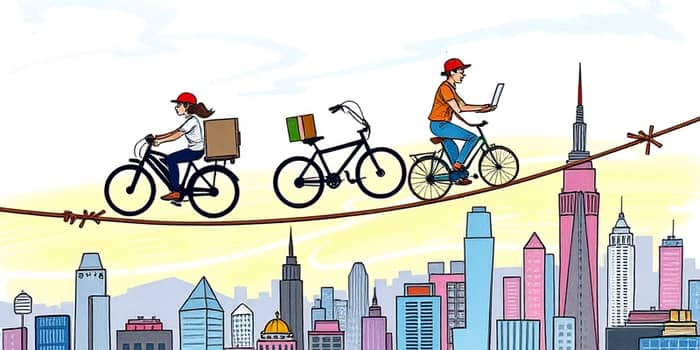
The rapid expansion of platform-based labor has captivated imaginations and headlines alike, promising freedom and opportunity on demand. But beneath the glossy statistics lies a more troubling reality: many workers bear the costs of innovation without enjoying its rewards.
Definitions, Scope, and Growth of the Gig Economy
To understand this transformation, we must first define the gig economy. Broadly, it refers to a labor market built on short-term contracts, freelance work, or on-demand tasks rather than traditional employment.
Within this framework, key categories emerge:
- Independent contractors, freelancers, consultants who sell expertise to multiple clients;
- Platform workers on apps like Uber, Lyft, Deliveroo, TaskRabbit, Mechanical Turk;
- Temporary agency workers hired through staffing firms for limited assignments;
- On-call and contingent workers who fill unpredictable shifts and urgent needs.
No single official definition exists: the U.S. Bureau of Labor Statistics tracks “contingent workers” and “alternative work arrangements,” but academic and policy studies vary widely, complicating comparisons. Yet even the most conservative estimates show a significant rise in this non-traditional labor.
By some measures, nearly one-third of U.S. workers now rely on gig work as their primary job or supplement their income through side gigs. Globally, the Mastercard index valued gig transactions at $204 billion in 2019, forecasting 17% annual growth through 2023. Despite these headline figures, the picture fragments once we examine who benefits and who pays the true price.
Economic Promise vs. Precarious Reality
Proponents of gig work celebrate its flexibility and autonomy: you can set your hours, work from anywhere, and be your own boss. For businesses, on-demand access to talent fills seasonal peaks and specialized project needs, while reducing fixed labor costs.
- Geographic independence and work-life balance attract many to flexible schedules;
- Multiple income streams allow freelancers to diversify earnings;
- Reduced overhead helps small firms compete on a global stage.
Yet this bright narrative overlooks structural forces that shape most gig roles. Algorithmic management and pay-per-task models often yield precarious, low-quality work with unstable incomes and minimal protections. Rather than accidental flaws, these conditions are baked into business models designed to externalize risk.
Precariousness: Income, Benefits, and Risk
At the heart of the gig economy’s dark side lies income volatility. Many workers struggle to meet basic needs when hours fluctuate or platforms shift commissions.
Consider these stark realities:
- Nearly 45% of gig workers cannot cover a $400 emergency expense without borrowing.
- Some ride-hail drivers report losing money once vehicle costs and downtime are factored in.
- Full-time temp agency workers earn about 41% less than standard employees and face disproportionate wage theft.
On top of fragile earnings, over half of gig workers have no access to employer-based benefits. Unemployment insurance, workers’ compensation, health coverage, paid leave, even minimum wage guarantees—these safeguards vanish under independent-contractor status.
This erosion of protections forces many into public assistance: 15% of gig workers rely on SNAP food stamps, including 13% of delivery couriers. Cornering low-wage workers into classification that denies a social safety net shifts costs onto individuals and society.
Health, Safety, and Unpaid Risks
Gig roles often come with heightened physical and financial dangers. Temp workers suffer higher on-the-job injury rates than permanent staff, due in part to insufficient training and assignments to riskier tasks. During the COVID-19 pandemic, couriers and rideshare drivers faced increased exposure without paid sick leave or employer health insurance.
Even when workers purchase private coverage, nearly 37% defer necessary medical care because premiums and deductibles are unaffordable. The result is a workforce compelled to carry their own risks with little institutional support.
Structural Inequality and Uneven Growth
The burdens of gig work fall disproportionately on marginalized communities, reinforcing existing inequities. African American and Latinx workers are overrepresented in the lowest-paying, highest-risk segments—delivery, ride-hail, temp agency assignments—while enjoying fewer opportunities for upward mobility.
Research shows Black workers comprise 12.1% of the overall labor force but account for 23% of app-based gig roles. Algorithmic bias, customer rating systems, and opaque assignment mechanisms can lock these workers into less profitable routes and tasks, deepening disparities.
Gender and educational divides further complicate the picture. Women often fill caregiving-adjacent gigs with irregular hours, while those with higher degrees may find more lucrative freelance consulting roles. Yet all remain vulnerable without collective bargaining rights or anti-discrimination protections.
Charting a Path Forward: Policy and Collective Action
Addressing the gig economy’s dark side demands multifaceted solutions. Policymakers, platforms, and worker organizations each have essential roles to play.
- Universal benefits portability would detach health, retirement, and leave entitlements from employer status, allowing workers to carry coverage across gigs.
- Clearer classification standards can prevent misclassification abuses and ensure fair wages, overtime pay, and collective bargaining rights.
- Transparent algorithms and accountability would mitigate bias in task allocation and customer ratings, leveling the playing field for all workers.
Some regions have piloted portable benefit accounts funded by a small levy on each gig transaction. Other advocates call for sector-wide bargaining units that can negotiate minimum pay rates and safety standards, regardless of employment classification.
On an individual level, gig workers can strengthen their position by banding together in cooperatives, pooling resources for insurance and training, and leveraging crowd-funded legal challenges to unfair platform policies.
Conclusion: Balancing Innovation and Equity
The gig economy exemplifies modern labor’s tensions: groundbreaking flexibility coupled with creeping precarity, dazzling growth shadowed by deep inequality. Recognizing the structural nature of these challenges is the first step toward crafting durable solutions.
By demanding portable benefits, enforcing fair workplace protections, and fostering collective power, society can harness platform-driven innovation without abandoning workers to a life of uncertainty. Only then can we realize an economy that truly benefits everyone, not just those at the top.
References
- https://www.ifac.org/knowledge-gateway/discussion/gig-economy-trends-and-impact-small-and-medium-practices
- https://dobetter.esade.edu/en/gig-economy-challenges
- https://guides.newman.baruch.cuny.edu/HRgigeconomy
- https://www.wgu.edu/blog/pros-and-cons-gig-economy1808.html
- https://www.adpresearch.com/research/the-gig-economy-a-tale-of-two-labor-markets
- https://www.epi.org/publication/gig-worker-survey/