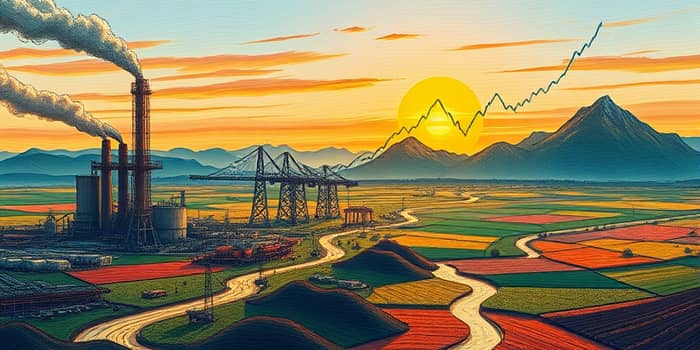
Commodity markets often move in predictable cycles, but multi-decade price surge events—known as supercycles—rewrite the rules entirely. These rare epochs, driven by seismic shifts in global demand and supply, transform economies, spur innovation, and test the foresight of investors, producers, and policymakers alike. Understanding their anatomy and history offers a roadmap to thrive when the world’s appetite for raw materials peaks.
Understanding Commodity Supercycles
At its core, a commodity supercycle is a prolonged period—often lasting a decade or more—when prices across a broad basket of energy, metals, and agriculture commodities remain substantially above their long-term average. Unlike ordinary cycles driven by short-term shocks, supercycles arise from persistent demand and supply shifts that outlast typical business fluctuations.
- Broad-based price moves across most major commodities
- Magnitude often involving a tripling or more in key price indices
- Lagged supply response due to long lead times for new mines and fields
- Boom and bust phases spanning decades
Lessons from History
Historical analysis reveals at least four supercycles since the late 19th century, each powered by waves of industrialization and reconstruction. From the US manufacturing boom at the turn of the century to Europe and Japan’s post-war rebuild, then China’s explosive growth since the 1990s, these eras underscore the link between mass urbanization and resource demand.
The 1970s and 2000s each saw commodity prices surge roughly 500% over a decade, while the post-2020 rally has already yielded nearly 200% gains in broad indices. Real energy and metal prices doubled between 2003 and 2008, and agricultural prices climbed 75%—hallmarks of a bona fide supercycle.
Structural Drivers Fueling the Boom
Several enduring forces underpin these extended booms. Rapid industrialization and urbanization in populous economies create colossal, synchronized demand. Meanwhile, long lead times for new capacity ensure that supply struggles to catch up.
- Population growth and expanding middle classes driving energy consumption
- Infrastructure spending—roads, ports, power plants—requiring vast material inputs
- Technological shifts, such as the green energy transition boosting demand for critical metals
Are We in a New Supercycle?
Debate rages over whether the post-2020 price rally constitutes a fresh supercycle or a normal cyclical rebound. Advocates point to unprecedented monetary expansion, post-pandemic stimulus, and the energy transition. Skeptics warn of demand destruction from high prices and potential oversupply as greenfield projects ramp up.
Key indicators to watch include:
- Duration of elevated prices beyond short-term recoveries
- Broad-based participation across energy, metals, and agriculture
- Fundamental shifts—rather than inventory cycles—driving trends
Implications for Investors, Producers, and Policymakers
Supercycles reshape fortunes and policies. Investors who position early can capture outsized returns, but must manage volatility and timing risk. Producers face capital discipline choices: expand to meet demand or wait to avoid bust-phase overcapacity. Policymakers grapple with inflationary pressures and resource security concerns.
- Investors: diversify across commodity sectors and use hedging strategies to protect gains
- Producers: balance long-term projects with flexible scaling to avoid stranded assets
- Policymakers: encourage sustainable mining practices and strategic reserves to smooth cycles
Strategies for Riding the Boom
To navigate a potential supercycle, stakeholders should adopt a multi-pronged approach. Monitor leading indicators—such as global industrial output, PMI surveys, and capital expenditure plans. Incorporate scenario analysis to test portfolios and budgets under different price paths. Embrace innovation: from digital supply-chain tracking to low-carbon metallurgy, new technologies can both drive demand and improve efficiency.
Maintaining agility is crucial. During the upswing, lock in prices through long-dated contracts or options. As the cycle matures, watch for signs of oversupply: expanding inventory levels, rising break-even costs, or sharp declines in order backlogs. By anticipating the transition to a downswing, stakeholders can preserve capital and pivot to the next growth driver.
Conclusion
Commodity supercycles are rare but transformative chapters in economic history. Characterized by long-term price movements and deep structural shifts, they reward foresight and resilience. By learning from past booms, understanding current drivers, and implementing robust strategies, investors, producers, and policymakers can not only survive these resource waves but thrive in their aftermath.
References
- https://capital.com/en-int/analysis/commodity-supercycle-explained
- https://elements.visualcapitalist.com/what-is-a-commodity-super-cycle/
- https://uscfinvestments.substack.com/p/understanding-commodity-super-cycles
- https://www.heygotrade.com/en/blog/commodity-supercycle-explained/
- https://alpari.com/en/learn/commodity-super-cycles/
- https://hedgenordic.com/2024/10/a-map-of-the-evident-supercycle/
- https://www.dws.com/insights/cio-view/macro/a-commodity-supercycle/
- https://www.cmegroup.com/openmarkets/economics/2021/a-closer-look-at-commodities-supercycles.html
- https://www.benzinga.com/22/07/28249365/a-historical-analysis-of-commodity-cycles-from-the-1970s-to-2020s
- https://www.wrightresearch.in/blog/understanding-commodity-super-cycle-what-it-means-for-investors-in-2026/
- https://en.wikipedia.org/wiki/2000s_commodities_boom