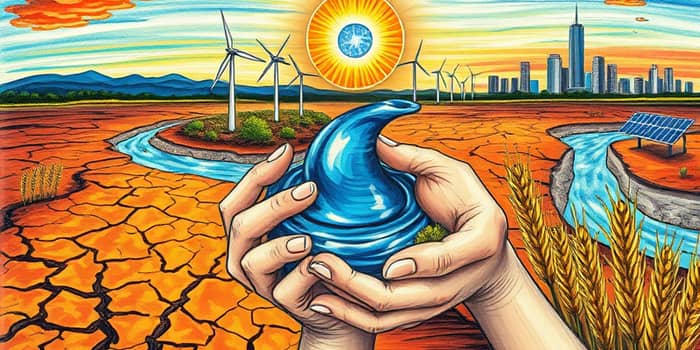
Every day we rely on water, food, energy, land, and minerals to sustain modern life. Yet these necessities are not unlimited. As demand grows and supplies dwindle, the question of how to value and allocate what we can still access becomes urgent and complex.
In the face of mounting pressures, understanding the roots of scarcity and how it shapes markets, policy, and individual choices is vital. This article explores the economic, ecological, and ethical dimensions of resource scarcity, offering practical guidance for steering toward a more sustainable and fair future.
Understanding Resource Scarcity
Resource scarcity occurs when demand for a resource approaches or exceeds available supply. This can take the form of physical scarcity, where finite deposits of freshwater, arable land, or high grade mineral ores cannot be replenished, and economic scarcity, where resources exist but are costly to extract with existing technology. Economics itself rests on the premise that resources are limited while human wants are not, making trade offs between needs and resources unavoidable.
As scarcity intensifies, its impacts ripple across commodity markets, geopolitical relations, environmental health, and the very feasibility of long term economic growth. The classic tension between a finite planet and infinite growth underscores why pricing and managing essentials of life is both a technical challenge and a moral imperative.
Surging Global Demand
Over the past five decades, total material use—including biomass, fossil fuels, metals, minerals, land, and water—has more than tripled. Projections suggest this will rise by another 60 percent by 2060 compared to 2020 levels, driving the triple planetary crisis of climate change, biodiversity loss, and pollution.
Key drivers of this surge include population growth, rising incomes, and rapid urbanization:
- Population growth towards nine billion people by 2050
- Three billion new middle class consumers by 2030
- Urban population swelling from three to five billion by 2030
These trends translate into soaring demand for essentials. By 2050, energy demand is expected to climb 40 to 50 percent, water use by 20 to 30 percent, and food consumption by 60 to 70 percent relative to 2020.
Finite Supply and Biophysical Limits
There are only about 13 billion hectares of land on Earth, of which roughly 11 percent is arable. The balance comprises mountains, deserts, wetlands, and protected areas that are difficult or irresponsible to convert for agriculture. At the same time, climate change, urban sprawl, and competition for freshwater intensify pressure on the land we must cultivate for food.
Demand projections for key resources by 2050:
Despite covering 70 percent of the planet, only 1 percent of water is easily accessible for human use. Agriculture alone consumes roughly 70 percent of freshwater withdrawals, while industry and domestic needs make up the rest. In many regions, groundwater is being depleted faster than it can be replenished, posing serious threats to future water security and agricultural productivity.
On the energy front, even rapid growth in renewables may only supply a third of global demand by mid century under current policies. Fossil fuels remain dominant, risking continued emissions growth. Meanwhile minerals required for renewable technologies face declining ore grades, fewer new discoveries, and rising geopolitical risks.
Inequality in Resource Use and Pricing
Not everyone consumes resources equally. High income countries use six times more materials per capita than low income ones and are responsible for ten times more climate impacts. When we talk about ethical pricing and equitable access, uniform global prices can hurt vulnerable populations disproportionately, raising ethical and political questions about how to allocate essential goods without deepening inequality.
We face the challenge of setting prices that reflect true scarcity and environmental costs, while ensuring that basic human needs remain affordable. Balancing these goals requires nuanced policy instruments, targeted subsidies, and international cooperation that acknowledges historical responsibility and differential capacities to pay.
Prices as Signals and Policy Implications
Higher prices naturally emerge when demand outpaces supply. In commodity markets, scarcity leads to price escalation, encouraging both consumers to conserve and producers to innovate. Electricity markets illustrate this dynamic sharply. When generation and reserve capacity are tight, prices can spike to many times their normal levels, sometimes rocketing by thousands of percent during extreme shortages.
The concept of shortage pricing in competitive electricity markets relies on valuing operating reserves at the estimated cost of involuntary load shedding. As reserve shortages deepen, the probability of outages rises, pushing prices higher. Properly designed, these price signals incentivize fast ramping resources, demand response measures, and investments in new flexible generation.
However, extreme price volatility challenges households and businesses. Risk management tools such as long term fixed price contracts, efficiency measures, and demand side management can mitigate exposure to dramatic scarcity driven price swings.
Moving Towards a Sustainable Future
As consumers, policymakers, and businesses, we all have a role in addressing deepening global supply demand imbalances. By valuing resources more accurately, encouraging conservation, and incentivizing innovation and sustainable practices, we can ease pressure on ecosystems while nurturing economic resilience.
- Implement water saving technologies in agriculture and urban areas
- Support renewables and flexible grid investments
- Adopt circular economy practices to reduce waste
- Advocate for targeted pricing policies that protect low income households
On an individual level, reducing food waste, conserving energy, and choosing sustainable products can collectively make a significant impact. At the policy level, integrating environmental costs into prices, investing in infrastructure for efficiency, and ensuring fair distribution of essential goods are vital steps.
Ultimately, by recognizing that limited yet vital resources define our shared future, we can forge a path that balances growth with stewardship, securing the essentials of life for generations to come.
References
- https://courses.ems.psu.edu/ba850/node/642
- https://www.weforum.org/stories/2024/03/sustainable-resource-consumption-urgent-un/
- https://www.hannover-re.com/en/property-and-casualty/emerging-risks-insights/resource-supply/
- https://pmc.ncbi.nlm.nih.gov/articles/PMC4036828/
- https://www.igs.com/energy-resource-center/energy-101/understanding-scarcity-pricing-and-its-impact
- https://www.potomaceconomics.com/uncategorized/what-is-shortage-pricing-and-why-is-it-essential-in-competitive-electricity-markets/
- https://pmc.ncbi.nlm.nih.gov/articles/PMC9520963/
- https://www.youtube.com/watch?v=1QekIzTQOI8