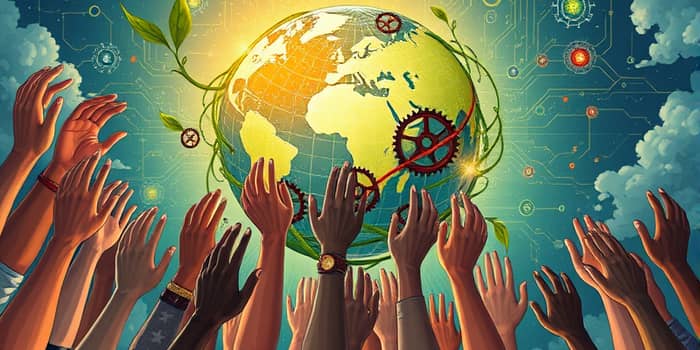
Capitalism is no longer simply an economic framework of the past two centuries; it has become a defining force in how we live, work, and govern. Today, it stands at a systemic crossroads demanding bold choices that go beyond routine policy tinkering. Inequality, instability, ecological limits, democratic erosion, and digital concentration have converged to expose the limits of a model built on shareholder primacy and unbridled growth. As public trust falters and crises multiply, we face a historic opportunity to reimagine the system itself rather than merely patch its fractures.
Why Capitalism Stands at a Crossroads
Contemporary capitalism is under sustained attack from multiple fronts, revealing deep contradictions in the post-1970s model of globalized markets and minimal regulation. Four interlinked crises make clear that the classic formula of endless growth and profit maximization is no longer tenable:
- Inequality and wealth concentration have soared as financial markets overshadow production, creating vast gaps between corporate elites and working families.
- Instability and crisis-proneness arise from recurring debt cycles, speculative bubbles, and systemic volatility that threaten long-term prosperity.
- Ecological limits and climate crisis challenge the viability of an economy built on infinite expansion in a finite biosphere.
- Digital surveillance and platform power shift control of data and social behavior into the hands of a few technology giants.
- Democratic erosion and corporate influence undermine public accountability as special interests shape policy and warp political processes.
These pressures are not isolated; they feed one another, producing a cycle of despair and distrust. Communities overwhelmed by environmental disasters, workers burned out by insecure labor, and citizens alienated from democratic institutions demand more than incremental fixes. They call for a fundamental transformation in how the economic system operates and whom it serves.
From Industrial Might to Digital Domination
At its root, modern capitalism has shifted from the managerial hierarchies of industrial production to a world shaped by algorithms, platforms, and global financial flows. In the decades following the 1970s, deregulation and market liberalization fueled a surge in shareholder value, but also encouraged the growth of speculative trading and corporate consolidation. The rise of digital platforms has further concentrated power, as user data becomes a form of capital and attention transforms into profit.
This evolution has bestowed incredible innovations—instant global communication, unprecedented access to services, and new business models. Yet it has also produced work precarity, privacy violations, and algorithmic biases. When data monopolies dictate discourse, and gig labor platforms erode traditional protections, the question becomes: can we adapt capitalism to human values rather than reshape human behavior to fit corporate goals?
The Failures of the Current Model
Many of the defining features of late-stage capitalism reveal systemic failures rather than strengths. Growth often occurs without broad distribution, leaving wages stagnant while asset prices soar. Profit can be generated without regard to environmental sustainability, depleting natural resources and accelerating climate change. Innovation sometimes proceeds without fairness, entrenching monopolies and excluding small entrepreneurs. Efficiency gains may come at the cost of democratic checks and social cohesion.
These contradictions have real-world consequences. Families struggle under mounting debt, communities face growing food and energy insecurity, and ecosystems reach tipping points. The moral bond between citizens and their economic system weakens when neoliberal assumptions prioritize markets above people and planet.
Paths Toward a Renewed Economy
Faced with this multifaceted crisis, thought leaders and activists propose a spectrum of reforms and alternative models. Each path seeks to address the root causes of capitalism’s contradictions by rebalancing power, redefining success, and embedding ecological and democratic priorities into economic life.
- Mixed economies with state-private coordination blend market dynamism with public direction, using industrial policy to steer investment toward social and environmental goals.
- Degrowth and solidarity economy champion voluntary contraction of harmful industries, community cooperatives, and shared ownership to foster resilience and equity.
- Green New Deal frameworks call for large-scale public investment in clean energy and job creation, tying climate action directly to social welfare.
- Stakeholder and mission-based firms reorient corporate governance to balance the interests of workers, communities, and the environment alongside investors.
- Socialism with Chinese characteristics combines private enterprise, state ownership, and party oversight to achieve rapid development, albeit with trade-offs in political freedom.
These models vary in their ambitions and trade-offs, but share a willingness to question the assumption that markets alone can solve deep social and environmental challenges. They invite communities, policymakers, and businesses to imagine an economy that prioritizes well-being over raw GDP and democratic flourishing over unregulated corporate influence.
The Unfinished Question
No single blueprint will satisfy every stakeholder, and transitional strategies carry their own risks. Reformers worry that half-measures may entrench existing power structures, while more radical proposals can struggle to garner broad political support. Yet the debate itself marks progress: we are no longer confined to a narrow choice between laissez-faire capitalism and state socialism.
Instead, the task before us is to co-create a system that acknowledges ecological constraints, restores democratic legitimacy, and distributes wealth and opportunity more fairly. This requires new metrics of success—beyond quarterly earnings—and institutions that empower citizens to hold markets accountable. It demands that firms embrace purpose alongside profit, that governments safeguard common goods, and that individuals recognize their role in shaping economic norms.
Charting a Collective Future
As we stand at this historic crossroads, each of us has a role to play. Consumers can support cooperatives and ethical businesses. Workers can advocate for democratic governance and fair wages. Voters can demand policies that curb corporate power and invest in green infrastructure. Entrepreneurs can design innovations that serve societal needs, not just market niches. And policymakers can forge alliances across parties to embed social and environmental standards into law.
Reimagining capitalism is not a distant academic exercise; it is a collective journey that begins in our neighborhoods, workplaces, and political arenas. By recognizing the system’s built-in limits and embracing creative alternatives, we can build an economy that sustains both human dignity and planetary health. At this crossroads, the path we choose will define generations to come—and the time to act is now.
References
- https://www.youtube.com/watch?v=Av_J87Ia0WI
- https://humanact.org/what-is-modern-capitalism/
- https://www.springerprofessional.de/en/capitalism-at-a-crossroads/24067444
- https://www.demos.org/blog/biggest-problem-capitalism-nobody-talks-about
- https://hbr.org/2011/01/capitalism-at-a-crossroads
- https://www.hbs.edu/bigs/capitalism-systemic-challenges-and-solutions
- https://www.emerald.com/ijse/article/23/9/41/158246/Capitalism-at-the-crossroads
- https://ideas.repec.org/a/fip/fedbrr/y2002iq3p4-10nv.12no.3.html
- https://www.peterlang.com/document/1111070
- https://www.bostonfed.org/publications/regional-review/2002/quarter-3/challenges-of-modern-capitalism.aspx
- https://en.wikipedia.org/wiki/Criticism_of_capitalism