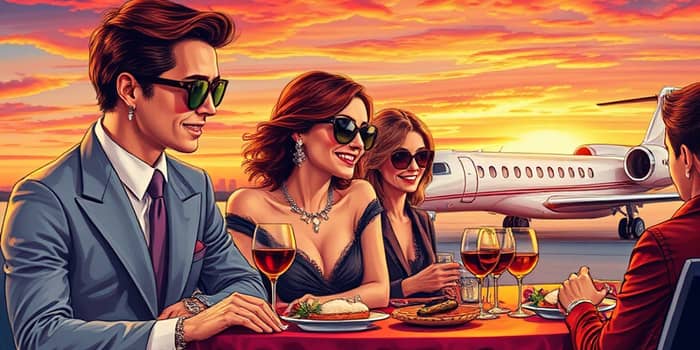
The global luxury goods market is entering a new chapter. After the tumultuous years following the pandemic, industry leaders describe 2026 as a phase of strategic normalisation with sustainable growth where value-oriented strategies over pure volume and profitable growth over broad expansion take center stage.
BNP Paribas projects roughly 6% organic sales growth in 2026 following a flat 2025, while Deloitte research highlights that 66.9% of executives expect stable or growing revenues and 70.7% aim to maintain or improve margins. Brands are tightening assortments, focusing on pricing power, and prioritizing high-value clients.
The Evolving Landscape of Luxury
Luxury can be divided into distinct categories, each with its own trajectory and customer appeal:
- Personal luxury goods (fashion, leather, watches, jewelry, beauty)
- Experiential luxury (prestige hospitality, fine dining, curated travel)
- Automotive and other big-ticket luxury items
Experiential offerings are surging ahead, with prestige hospitality and gastronomy expected to maintain a CAGR of about 8% through the mid-2020s, outpacing many traditional personal goods segments.
Profiling the Modern Affluent Consumer
Millennials and Gen Z are transforming the industry. Clarkston projects they will represent around 75% of luxury buyers by 2026, up from 45% in 2025. These cohorts demand relevance, interactivity, and purpose.
- Digital-native habits (social media, livestream commerce)
- Demand for authenticity, cultural relevance, and ethics
- Willingness to reward brands that build real relationships
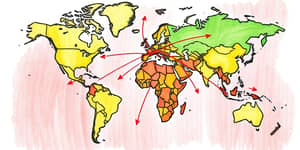
Geographically, five regions will drive growth in 2026:
China remains the single most influential growth engine, buoyed by a 25-million-strong affluent population and a rebound in spending as new high-income sectors expand. Japan and the Middle East benefit from domestic demand and tourism, while India’s rising upper class spurs investment in luxury retail. The US shows a bifurcation: truly ultra-wealthy consumers drive demand even as upper-middle segments exercise caution.
Key Trends Shaping Luxury Consumption
Brands are reimagining how they engage customers, moving beyond transactions to forge enduring bonds.
- one-to-one relationships using data through hyper-personalized clienteling
- Exclusivity via immersive events and limited-edition drops
- Empowering store associates as brand storytellers
Technology is accelerating this shift. More than 40% of luxury firms are scaling up GenAI for design, customer service, and content creation. Livestream and social commerce are becoming vital channels, blending entertainment with seamless purchasing.
Sustainability has moved from niche to norm. Brands are adopting circular models, from resale platforms to take-back programs, and setting ambitious carbon reduction targets. Consumers now expect clear progress reports and transparent supply chains.
Ethical and Environmental Perspectives
Affluent consumption carries a significant environmental footprint. The wealthiest 0.54% of individuals drive 14% of lifestyle-related greenhouse gas emissions, while the bottom 50% account for just 10%. Americans, 4% of the global population, consume 25% of the world’s energy.
Efficiency gains and clean technologies have not offset the growth in high-end consumption. This dynamic fosters positional consumption and status signaling, perpetuating a spiral of ever-higher material and experiential demands.
Thought leaders argue for a shift toward sufficiency-oriented lifestyles, urging both brands and consumers to balance aspiration with impact, and to view luxury as a catalyst for positive change rather than unchecked indulgence.
Practical Insights for Conscious Engagement
Consumers can begin by defining their values around quality, ethics, and purpose. Research brands’ sustainability commitments and choose those with transparent sourcing, fair labor practices, and community initiatives.
Prioritize items and experiences that align with personal vision. Embrace resale, rental, and refurbishment to extend the life cycle of luxury pieces. Seek out immersive experiences that blend artistry with ethical stewardship, placing experiences over material possessions.
Leverage digital platforms to compare practices, join loyalty communities that reward ethical behavior, and engage directly with artisans and designers to gain insight into the craftsmanship and impact behind each creation.
Industry professionals should harness data to deliver truly personalized journeys, moving beyond segmentation toward genuine human connection. Invest in training teams to communicate sustainability stories effectively, and embed circular principles from design to delivery to champion conscious and sustainable choices.
By uniting growth with purpose, the luxury sector can lead the way in innovation, design, and social responsibility—transforming affluence into a force for good and setting new standards for lasting value beyond fleeting indulgence.
References
- https://clarkstonconsulting.com/insights/2026-luxury-retail-trends/
- https://grandchallenges.unsw.edu.au/article/affluence-killing-planet-warn-scientists
- https://www.deloitte.com/global/en/industries/consumer/perspectives/global-powers-of-luxury.html
- https://overconsumption.org/blogs/news/understanding-overconsumption-a-global-perspective
- https://cib.bnpparibas/2026-luxury-goods-sector-outlook/
- https://pmc.ncbi.nlm.nih.gov/articles/PMC153663/
- https://www.youtube.com/watch?v=8_AgfwlZw_k
- https://us.fashionnetwork.com/news/The-luxury-market-set-to-enter-phase-of-strategic-normalisation-in-2026,1823701.html
- https://www.resilience.org/stories/2020-06-20/scientists-warning-on-affluence/
- https://the-silent-luxury.com/us-luxury-market-bifurcation-defiant-value-2026/
- https://sciencespo.hal.science/hal-03905891/document
- https://www.whowhatwear.com/fashion/shopping/luxury-fashion-trends-2026
- https://www.bspk.com/post/global-luxury-retail-trends-2026