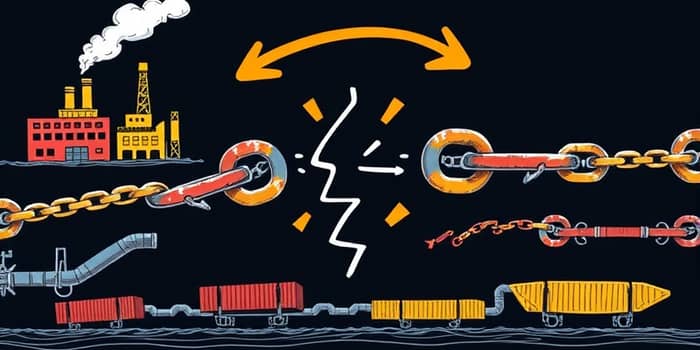
Supply shocks can strike unexpectedly, sending prices skyrocketing and supply chains into turmoil. In this comprehensive exploration, we dissect the lifecycle of a supply shock—from its initial spark, through widespread propagation, to the critical recovery strategies that foster anti-fragility.
Understanding Supply Shocks
At its core, a supply shock represents a sudden change in availability of a product, commodity, or service. Economists describe a negative supply shock as an inward aggregate supply shift, which simultaneously elevates inflation and depresses output and employment.
From a micro perspective, operational disruptions interrupt a firm’s input flow, logistics, capacity, or supplier network. At the macro level, shocks manifest as an economy-wide reduction in productive capacity or a surge in input costs, rippling through price levels and real GDP. Historical episodes such as the 1973 oil embargo and the stagflation era underscore the severity of price-level supply shocks, driven by energy spikes and policy changes.
Triggers: What Sparks a Shock?
Supply shocks arise from a diverse array of catalysts. While natural disasters and pandemics garner headlines, cyberattacks, labor shortages, and policy shifts can be equally disruptive. Triggers may include:
- Natural disasters (earthquakes, tsunamis, hurricanes)
- Pandemics and widespread health emergencies
- Cyberattacks on logistics or coordination systems
- Transportation delays due to congestion or labor disputes
- Sharp price fluctuations in critical inputs like energy or metals
- Regulatory or policy shocks, including removal of price controls
For example, the 2011 Japanese tsunami halted factories that produced over half of key auto parts worldwide. Similarly, the COVID-19 pandemic affected more than 900 Fortune 1000 companies through Tier 1 or Tier 2 supplier disruptions, at times completely stopping production.
Propagation: How Shocks Spread
Once a trigger hits, the shock radiates through supplier tiers, transport networks, and pricing channels. A missing component delays final assembly, shipping delays extend lead times, and labor constraints slow every stage from harvesting to delivery. Rising input costs are passed downstream, generating inflationary momentum.
Central banks face a stark dilemma: the single nominal policy interest rate is their only tool. To combat inflation, they must raise that rate by more than expected inflation, thereby increasing real interest rates and suppressing aggregate demand. This inevitably lowers output and employment, at least temporarily, until the economy returns to equilibrium.
Recovery: Building Resilience and Thriving
Recovery is more than restoration; it is the foundation of resilience and the path toward anti-fragility. Effective recovery combines operational tactics with strategic foresight to rebuild supply capacity and guard against future shocks.
- Supply chain mapping to uncover hidden Tier 2 suppliers and geographic risks
- Diversification of suppliers to avoid single points of failure
- Backup inventory and safety stock to reduce stockout risk
- Comprehensive contingency planning for prevention and response
- Enhanced transparency using RFID, WMS, and real-time tracking
Empirical data underscores the urgency: input costs across 52 items surged by an average of 95% above pre-pandemic levels. Labor shortages contributed to 11 million job openings in December 2021, exacerbating supply strain and fueling inflation to a 29-year high. Even when production restarts, some operations may take up to 50 trading days to resume full capacity.
Looking Ahead: Cultivating Anti-Fragility
While robustness allows supply chains to resist change, anti-fragility means improving because of it. Firms can leverage post-shock momentum to implement innovations, refine processes, and strengthen collaboration across tiers.
Key steps include documenting disruption triggers and flows, investing in digital visibility, and embedding continuous improvement loops. By treating every supply shock as a learning opportunity, organizations evolve adaptive networks that thrive amid uncertainty.
Ultimately, mastering the anatomy of a supply shock—from trigger through propagation to recovery—empowers firms and policymakers to navigate disruptions, stabilize economies, and emerge stronger than before.
References
- https://books.core-econ.org/the-economy/macroeconomics/05-macroeconomic-policy-05-negative-supply-shock.html
- https://www.naspo.org/news/supply-chain-fragility-and-disruption-recovery/
- https://www.stonex.com/en-us/business/financial-glossary/supply-shock/
- https://www.partnerlinq.com/blog/the-slow-recovery-of-supply-chains-how-to-overcome-the-current-disruption
- https://www.jstor.org/stable/26591919
- https://www.newcastlesys.com/blog/5-ways-to-recover-from-supply-chain-disruptions
- https://ideas.repec.org/a/cup/jfinqa/v53y2018i02p547-579_00.html
- https://www.ecb.europa.eu/press/economic-bulletin/focus/2022/html/ecb.ebbox202108_01~e8ceebe51f.en.html
- https://pmc.ncbi.nlm.nih.gov/articles/PMC7792559/
- https://www.kaggle.com/datasets/likithagedipudi/supply-chain-disruption-and-recovery-dataset