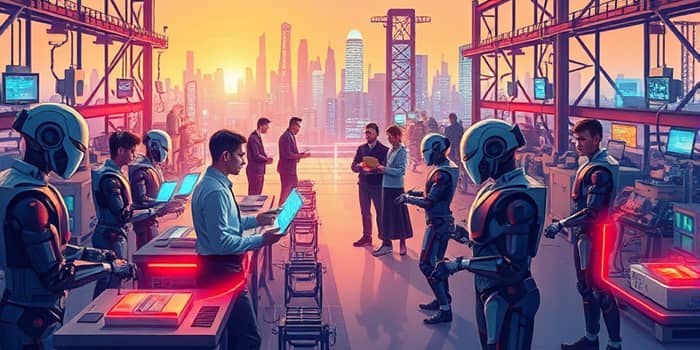
In today's rapidly evolving economy, multi-wave and continuous automation is reshaping how we work, live, and share prosperity. The ascent of industrial robotics, information technology, and now advanced artificial intelligence has ushered in fundamental transformations. Far beyond simple job loss, these changes restructure the task content of work, redefine skills, and redistribute risks and rewards across individuals, communities, and nations.
The Two Faces of Automation
Economists identify two primary effects driving this transformation. The first is the displacement effect substitution of labor, where technology takes over tasks historically performed by humans—online platforms replace travel agents, automated kiosks supplant cashiers, and driverless vehicles challenge transportation workers. The second is the productivity expansion effect generating new roles, whereby improved efficiency lowers costs, spurs demand, and fosters entirely novel occupations and industries.
- Displacement of routine, manual, or clerical tasks.
- Creation of jobs through enhanced productivity and innovation.
Over the long run, historical evidence indicates that automation often creates at least as many jobs as it destroys. However, the timing, location, and nature of these roles differ dramatically. Workers may need to migrate, retrain, and adapt to entirely new sectors to seize emerging opportunities.
Measuring the Impact: Numbers at a Glance
Quantifying automation’s ascendancy requires blending historical data with projections. Since 2000, American manufacturing lost roughly 1.7 million positions even as global robot deployment tripled. By 2030, analysts forecast over 20 million industrial robots worldwide, with China potentially hosting 14 million. Surveys suggest nearly 30% of U.S. jobs could be fully automated by 2030, and about 60% will experience significant task alterations.
Country-level analyses further highlight variation. In the United States, generative AI could affect tasks for 12.8 million workers, potentially displacing 1.6–3.2 million over two decades. In England, up to 1.5 million jobs face high automation risk. Globally, exposure spans 300 million positions, roughly 9% of all roles.
Sector-specific studies reveal nuanced patterns: while manufacturing and clerical roles bear the brunt of displacement, technology, healthcare, and green energy sectors drive much of the job creation. This patchwork of change underscores the need for targeted strategies that account for local strengths and vulnerabilities.
How Jobs Evolve: Tasks, Skills, Wages
Rather than erasing entire occupations, automation often adds and removes specific tasks within jobs. David Autor’s longitudinal research shows that when automation offloads complex tasks, workers can be left performing simpler routines, triggering wage declines. Conversely, roles that emphasize judgment, creativity, and interpersonal skills tend to be augmented by intelligent machines, commanding higher salaries and increasing demand.
- Routine tasks are substituted, compressing wages.
- Complemented tasks boost productivity and pay.
- One-way fungibility of expertise limits upward mobility.
Automation also tilts the balance of bargaining power. As firms rely more on machines, the threat of substitution grows, weakening labor’s leverage. Falling automation costs amplify this effect, especially in economic downturns, deepening income polarization as profits shift toward capital owners and high-skill workers.
Winners and Losers: Equity Implications
Automation’s benefits and burdens are unevenly distributed across skill, race, gender, and geography. Routine task substitution disproportionately impacts middle-skill roles, hollowing out traditional pathways to the middle class. Meanwhile, high-skill professionals reap the rewards of complementing machines to boost productivity.
Race and ethnicity further complicate the picture. Black and Hispanic workers are overrepresented in 17 and 22 of the 30 U.S. occupations at the highest automation risk, respectively, from retail sales to transportation. Women also face significant exposure, with nearly 59 million in U.S. roles susceptible to AI-driven automation compared to 48.6 million men.
Regional disparities emerge as well. Economies built around manufacturing, clerical services, or extractive industries encounter sharper employment losses, while innovation centers with strong educational infrastructures absorb displaced workers more effectively. Without deliberate policies, these trends risk widening racial and ethnic inequalities and deepening urban–rural divides.
Strategies for Adaptation
Proactive measures can transform disruption into opportunity. Governments, businesses, and educational institutions must collaborate to design agile training ecosystems that anticipate evolving labor demands. Lifelong learning initiatives, micro-credential programs, and public–private partnerships can equip workers with the skills to transition smoothly into new roles.
- Individuals should cultivate adaptable, interdisciplinary skill sets.
- Companies can embed continuous learning into corporate culture.
- Policymakers need to strengthen safety nets and portable benefits.
Early interventions—such as subsidized reskilling, career counseling, and apprenticeship models—can mitigate displacement risks. Meanwhile, support for sectors poised for growth, like renewable energy and digital services, can channel displaced talent into high-opportunity fields.
Charting a Shared Future
Automation’s ascent is neither inherently triumphant nor tragically foreboding. Its ultimate impact hinges on our collective choices. By embracing inclusive workforce strategies, investing in human capital, and fostering equitable growth, we can ensure that intelligent technologies amplify human potential rather than supplant it.
The path forward demands vision and collaboration. From local community programs to global policy frameworks, stakeholders must unite around the principle that technological progress should serve humanity. When we align innovation with empathy and equity, automation can become a force for shared prosperity and lasting social advancement.
As we stand at this crossroads, the power of adaptation rests with each of us. Through resilience, creativity, and a commitment to lifelong growth, we can harness the promise of automation to build more vibrant and inclusive labor markets for generations to come.
References
- https://www.brookings.edu/articles/understanding-the-impact-of-automation-on-workers-jobs-and-wages/
- https://teamstage.io/jobs-lost-to-automation-statistics/
- https://www.goldmansachs.com/insights/articles/how-will-ai-affect-the-us-labor-market
- https://papers.ssrn.com/sol3/papers.cfm?abstract_id=5316265
- https://hai.stanford.edu/news/assessing-the-real-impact-of-automation-on-jobs
- https://www.chicagofed.org/research/content-areas/mobility/policy-brief-automation
- https://www.nu.edu/blog/ai-job-statistics/
- https://www.bcg.com/publications/2026/ai-will-reshape-more-jobs-than-it-replaces
- https://www.shrm.org/topics-tools/research/automation-generative-ai-job-displacement-risk-hr-employment
- https://www.bls.gov/bls/congressional-reports/assessing-the-impact-of-new-technologies-on-the-labor-market.htm
- https://www.designrush.com/agency/ai-companies/trends/ai-job-displacement-statistics