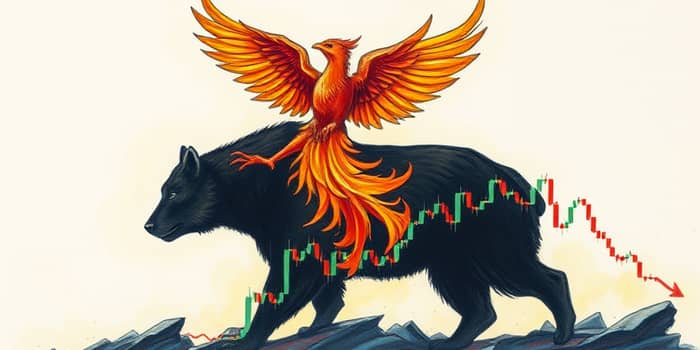
When prices plunge and headlines grow dark, many investors retreat. Yet hidden beneath the gloom lie chances to build lasting wealth. By understanding and embracing pessimism, you can transform fear into a strategic advantage.
Core Definitions and Baseline Concepts
Before diving into opportunity, it helps to define the terrain. Market downturns follow clear thresholds and patterns that repeat through history.
- Bear market (technical definition): A decline of 20% or more from a recent peak, lasting at least two months.
- Bull market: A rise of 20% or more from a market low, marking extended upward momentum.
- Market correction: A drop of 10–19.9% from recent highs, often a brief cooling before the next phase.
Since 1928, the S&P 500 has experienced 27 bear markets—about once every 3.5 years—and bull markets that average 4.3 years with cumulative gains near 150%. Despite average losses of 35% in downturns, stocks rebound and rise over the long run, illustrating an upward-sloping path that rewards patient investors.
Historical Context and Key Examples
Bear markets are dramatic but temporary. Some last only weeks, like the 33-day COVID-19 crash, while others, such as the Great Depression, spanned years. Unpredictable in timing, they share one constant: eventual recovery.
Recognizable episodes include:
- The Great Depression (1929–1932), the deepest downturn in modern history.
- The dot-com bust (2000–2002), driven by technology valuations collapsing.
- The Global Financial Crisis (2007–2009), sparked by a housing and credit collapse.
In every case, early pessimism sowed the seeds for spectacular rebounds, reminding investors that history of market recoveries favors those who endure.
Harnessing the Power of Pessimism
Pessimism is often cast as an enemy. Yet in finance, it can function as a catalyst for future gains. Three insights illustrate why:
- Pessimism of disbelief: After a downturn, low expectations set the bar for positive surprises, enabling quiet rallies to gather momentum.
- Peak pessimism buying: Sir John Templeton’s advice—“The time of maximum pessimism is the best time to buy”—reflects undervaluation when fear is at its height.
- Overreaction and mispricing: Extreme fear can push prices below fair value, creating opportunities for contrarian investors.
Academic research confirms that markets swing too far in both directions. When optimism wanes, asset prices dip below fundamentals. Savvy investors can step in to profit from pessimism before the tide turns.
Psychological Dynamics in Downturns
Fear drives selling. Loss aversion pushes investors to avoid further declines, even when bargains abound. Herding behavior amplifies moves, as individuals follow the crowd out of panic rather than reason.
Sentiment shifts also trigger sell-offs. Global conflicts, regulatory changes, and economic releases can send ripples through portfolios, reinforcing the cycle of downward pressure on valuations as more participants exit simultaneously.
Statistical Evidence: Opportunities Amid Pessimism
Notably, 42% of the S&P 500’s strongest single-day gains over the past two decades occurred during bear markets. Another 36% took place in the first two months of new bull runs—often when fear still lingered. Investors who exit at the first sign of trouble risk missing the bounceback’s most explosive moves.
Strategies to Thrive During Bear Markets
Successful downturn navigation relies on disciplined approaches rather than emotion-driven trades. Consider these tactics:
- Time in the market vs timing: Staying invested through declines captures recovery days that often come without warning.
- Dollar-cost averaging: Regular purchases during dips lower the average cost basis and smooth entry points.
- Valuation-based purchases: Focus on sectors and stocks with strong fundamentals trading at depressed multiples.
- Maintain liquidity reserves: Cash on hand allows opportunistic buying when prices fall sharply.
Conclusion: Embrace the Bear
Bear markets test resolve and provoke doubt, yet they also reset valuations and open doors to lasting gains. By learning the definitions, recognizing historical patterns, understanding psychological drivers, and applying disciplined strategies, investors can turn widespread pessimism into a source of strength.
Rather than fleeing the downturn, see it as a phase of renewal. Armed with data and a clear plan, you can harness the power of pessimism to build resilient portfolios poised for the next bull run.
References
- https://www.fisherinvestments.com/en-us/insights/market-commentary/ken-fishers-pessimism-of-disbelief-illustrated
- https://investor.vcm.com/insights/investor-learning/do-bear-markets-create-opportunity
- https://www.schwab.com/learn/story/how-to-invest-bear-market
- https://www.goldmansachs.com/insights/articles/are-bear-markets-in-stocks-an-investment-opportunity
- https://www.gmo.com/americas/research-library/memo-to-the-virtual-investment-committee-ii-fear-and-the-psychology-of-bear-markets_whitepaper/
- https://www.fidelity.com/learning-center/smart-money/bear-market
- https://www.westpac.com.au/personal-banking/share-trading/education/bull-and-bear-markets/
- https://www.quiverfinancial.com/blog/bear-market-trading-strategies-downturn-investing-guide/
- https://www.investor.gov/introduction-investing/investing-basics/glossary/bear-market
- https://www.youtube.com/watch?v=hpbDmEK-FvM
- https://walknercondon.com/blog/bear-market-definition-history/
- https://www.emerald.com/rbf/article/16/6/998/1234069/Stock-price-overreaction-evidence-from-bull-and
- https://www.hartfordfunds.com/practice-management/client-conversations/managing-volatility/bear-markets.html