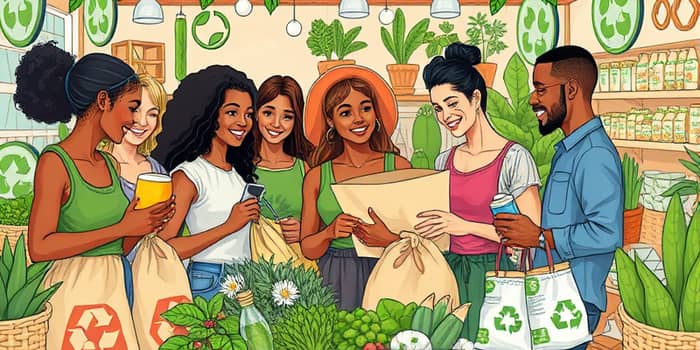
In an era of unprecedented choice and planetary pressure, every dollar we spend has ripple effects on the environment, society, and our shared future. As consumers awaken to the weight of their wallets, they assert a brand of economic influence that transcends mere transactions.
Becoming a conscious consumer means redefining the purpose of purchases, seeing them not just as commodities but as instruments of change. This article explores the why, the who, and the how of spending with purpose and power, offering practical levers that anyone can pull to align money with deeply held values.
Understanding Ethical and Values-Driven Consumption
At its core, ethical conscious consumption involves explicitly considering the social and environmental impacts of goods and services. It is a response to traditional buying patterns that prioritize convenience and cost over stewardship.
We can distinguish between:
- Eco-conscious consumers, who focus on carbon footprints, resource use, and biodiversity protection.
- Ethical consumers, who widen the lens to labor rights, equity, and animal welfare.
- Conscious consumers, an umbrella group that also emphasizes self-care, mental health, and authentic living.
This continuum underscores that conscious consumption is not about perfection but about continuous improvement and trade-offs—balancing idealism with real-world constraints like budget and availability.
The Cost of Conventional Consumerism
Today’s dominant economic model follows a linear “take-make-waste” trajectory, underpinned by resource extraction, mass production, rapid consumption, and disposal. This cycle has profound hidden costs.
- Raw materials are often non-renewable, leading to ecosystem disruption and climate destabilization.
- Manufacturing frequently occurs in regions with lax regulations, resulting in toxic by-products and human rights abuses.
- Products ignore negative externalities like pollution, worker underpayment, and habitat destruction, shifting the burden onto communities and future generations.
- Planned obsolescence drives repeat purchases of electronics, fast fashion, and household items, fueling waste.
As waste volumes have doubled over the past 30 years, our landfills and oceans overflow. A “throwaway culture” of single-use plastics and fleeting trends has made waste reduction an urgent priority.
The Rise of Values-Driven Consumers
Recent data reveal that conscious consumption is moving from niche to mainstream. Global surveys show:
- 89% of consumers have shifted toward more eco-friendly habits.
- 80% are willing to pay a premium for sustainable products.
- 91% will shop eco-friendly by 2025, with 10% buying exclusively sustainable goods.
- Eco-friendly retail spending in the U.S. hit $230 billion in 2025 and is projected to exceed $544 billion by 2032.
Yet even as sustainability becomes a baseline expectation, more than 60% of buyers still rank affordability as their top decision driver. This reveals a core tension: values versus budget.
Bridging Values and Budget
Navigating trade-offs requires a strategic mindset. Conscious consumers often adopt hybrid approaches such as buying fewer items of higher quality while mixing value-brand basics with premium ethical labels.
Tools like price-per-use calculators, secondhand marketplaces, and community co-ops help stretch every dollar further. Embracing a mindset of mindful frugality and empowerment transforms constraints into creative solutions that amplify impact.
Table: Domains of Conscious Consumption and Action Examples
Leveraging Your Purchasing Power
Beyond individual choices, conscious spending operates at multiple levels:
Every purchase signals market demand. When consumers favor brands with transparent supply chains and rigorous standards, companies respond by shifting sourcing, reformulating products, and investing in responsible practices.
Embedding Conscious Choices into Daily Life
To make lasting change, integrate conscious actions into your routines. Consider these practical levers:
- Research certifications and labels—understand what fair trade, B Corp, and carbon-neutral claims truly mean.
- Track your spending—use budgeting apps that categorize and visualize the impact of eco-friendly versus conventional purchases.
- Engage with brands—ask questions, provide feedback, and participate in online communities that hold corporations accountable.
- Support policy change—co-sign petitions, vote for candidates who champion sustainable regulation, and join local campaigns against pollution.
Small daily actions compound. Choosing a reusable coffee cup saves hundreds of disposable cups annually. Swapping fast fashion for one durable piece reduces landfill contributions and supports ethical artisans.
Conclusion: The Collective Impact of Individual Choices
Conscious consumption is not a solo endeavor but a collective movement. Each person’s decision becomes a data point in the marketplace, signaling priorities that shape corporate strategies and public policies.
By aligning spending with purpose, consumers unlock transformative economic power, catalyzing shifts toward a more just and sustainable world. The journey involves experimentation, learning, and resilience, but every step forward brings us closer to a future where profit and planet coexist in harmony.
Embrace your role as a conscious consumer, wield your wallet as an expression of values, and join millions who believe that what we buy today determines the world we inherit tomorrow.
References
- https://www.salsify.com/blog/top-10-consumer-trends-to-watch
- https://environbuzz.com/ethical-consumption-and-its-impact-on-the-environment/
- https://escalent.co/blog/top-consumer-trends-2026-market-research-insights-brands-need-to-build-winning-strategies/
- https://activesustainability.com/positive-society/consumer-society-environmental-impact-planet
- https://capitaloneshopping.com/research/eco-conscious-consumer-statistics/
- https://www.thinkers360.com/tl/blog/members/spending-with-purpose-how-your-wallet-can-change-the-world
- https://nielseniq.com/global/en/insights/report/2025/consumer-outlook-guide-to-2026/
- https://crossmining.smm-g.com/column/ethical-consumption/
- https://leadthechange.bard.edu/blog/can-businesses-be-both-profitable-and-ethical
- https://www.youtube.com/watch?v=TuallPSTJH4
- https://www.tandfonline.com/doi/full/10.1080/23251042.2023.2277971
- https://www.netguru.com/blog/consumer-behavior-trends
- https://globalyouth.wharton.upenn.edu/articles/environment/does-business-have-an-ethical-responsibility-to-help-save-the-planet/