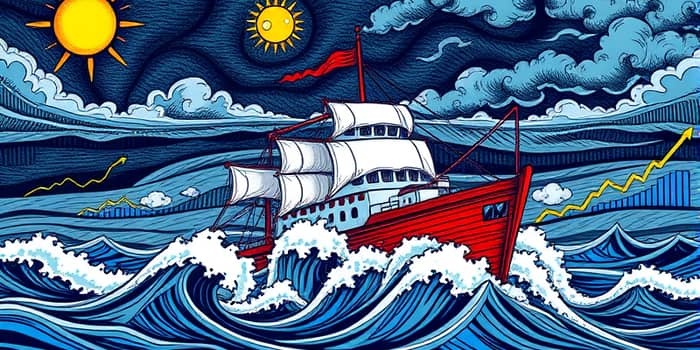
In today’s interconnected world, economic and environmental volatility can crash ashore without warning. Understanding how to stay afloat during downturns and disasters is essential for households, businesses, and communities alike. This article offers a comprehensive guide to anticipating shocks, strengthening your foundation, and adapting to whatever waves lie ahead.
Understanding the Economic Waves
The metaphor of “economic waves” captures a broad spectrum of forces that buffet our lives. At the macro level, global recessions, commodity price shocks, inflation spikes, and currency swings can erode demand, trigger layoffs, and undermine consumer confidence.
Beyond these systemic tremors, sectoral shifts—such as manufacturing offshoring, rapid tech disruption, or an energy transition—can decimate entire industries and communities overnight. When a major plant closes or supply chains relocate, the impact is felt in lost wages and idle factories.
Natural disasters, pandemics, conflict, and cyberattacks may not be inherently economic, but their fallout—storm-damaged homes, disrupted transport, or overwhelmed hospitals—ripples across markets. Even at the household level, unexpected job loss, medical emergencies, or debt problems can interact with broader crises to deepen financial hardship.
When we speak of staying afloat in any economic or environmental climate, we mean equipping every level of society with the tools to weather storms—literal and figurative—and emerge ready to rebuild.
The Scale of Modern Shocks
Recent research shows that extreme heat and severe droughts shave roughly 0.2% off national GDP, amounting to billions of dollars at risk each year. Countries heavily reliant on agriculture suffer most when temperatures exceed 95°F (35°C), even as industrial economies feel the squeeze from reduced consumer spending on mild-weather days.
Globally, weather-related disasters already cost economies tens of billions annually, and these events are rising in frequency and intensity. By 2030, climate change may drive 68 to 135 million people into poverty, reversing decades of progress and widening inequality.
Non-climatic shocks also hit hard. The 2008 global recession wiped out trillions in market value, while the COVID-19 pandemic disrupted supply chains, shuttered businesses, and highlighted the fragility of social safety nets worldwide. These waves remind us that risk is multifaceted and relentless.
Economic Resilience: Concept and Dimensions
At its core, economic resilience is the ability to anticipate, absorb, recover, and adapt to shocks without sacrificing long-term development. It applies across multiple levels:
Quantitative studies suggest about one-third of populations in low- and middle-income countries are highly vulnerable to shocks based on income volatility, limited access to services, and geographic risk. Regions vary in their capacity to resist short-term losses and to pivot structurally toward new growth paths.
Key Determinants of Resilience
- Economic Factors: diversification, innovation, productivity, infrastructure quality
- Social Factors: education levels, health status, community cohesion
- Institutional Factors: governance quality, land-use planning, emergency management
Cultivating these factors builds the foundations for sustainable recovery. Diversified industries cushion against sectoral downturns, while robust digital and transport systems keep commerce moving when physical networks falter.
Strategies for Communities and Regions
- Identify and mitigate persistent weaknesses
Conduct long-range economic scans to spot overreliance on single employers, skill gaps, or infrastructure deficits and integrate findings into development plans. - Implement early-warning and monitoring tools
Use dashboards, scorecards, and state-of-the-region reports to track employment trends, income levels, housing health, and climate risks. - Build organizational and financial flexibility
Support business continuity planning, ensure access to emergency funds and flexible credit lines, and develop contingent budgets for rapid response. - Promote a forward-looking regional vision
Frame economic disruptions as catalysts for renewal—transitioning to cleaner energy, upgrading skills, and attracting emerging industries. - Leverage innovative resilience financing
Explore resilience and catastrophe bonds that tie funding to risk reduction projects, while advancing methods to quantify avoided damages and downtime benefits.
By embedding resilience in planning and budgeting, communities can transform vulnerability into opportunity, ensuring that each setback becomes a stepping stone to greater strength.
Practical Steps for Firms and Households
- Diversify income streams and markets
Businesses should explore new products or geographies, and households can seek side incomes or gig opportunities to spread risk. - Maintain robust emergency reserves
Firms need liquidity cushions, and individuals should target savings that cover three to six months of expenses alongside adequate insurance. - Invest in adaptive skills and technology
Continuous learning, digital proficiency, and automation can shield both workers and companies from obsolescence. - Strengthen social networks
Community peer groups, professional associations, and mutual-aid forums provide critical support when formal systems strain. - Practice scenario planning and drills
Regularly run tabletop exercises for disasters or market shocks to refine response plans and communication protocols.
At every level, preparedness reduces panic. When families and firms know their contingency pathways, they can move swiftly from crisis response to recovery and growth.
Looking Ahead: Building a Resilient Future
Ultimately, resilience is not a static state but a journey of continuous improvement. By weaving economic diversification, social cohesion, and institutional strength into our daily choices, we create systems that not only survive adversity but emerge stronger.
As we face rising climate uncertainties and fast-evolving markets, the capacity to absorb, adapt, and innovate will define success. Whether you manage household budgets, run a startup, or guide regional policy, embedding resilience thinking today ensures that tomorrow’s waves become opportunities rather than threats.
References
- https://news.ufl.edu/2024/09/weather-economy/
- http://toolkit.climate.gov/economics
- https://econreview.studentorg.berkeley.edu/staying-afloat-developing-economies-in-the-age-of-climate-change/
- https://openknowledge.worldbank.org/entities/publication/a0878972-07ce-5642-8e8a-ad16d1ec2749
- https://arch.umd.edu/our-work/research-centers-institutes/environmental-finance-center/projects-publications/staying-afloat-assessing-long-term-financial-impacts-sea-level-rise-adaptation-solutions-historic-coastal-community
- https://www.youtube.com/watch?v=_XsmGeXZ-ok
- https://www.nrdc.org/stories/what-are-effects-climate-change
- https://pmc.ncbi.nlm.nih.gov/articles/PMC1280424/