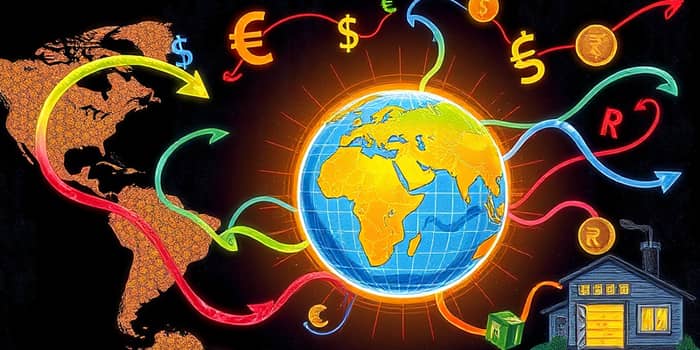
Every day, unseen rivers of money surge across borders, shaping the cost of goods on shelves, the jobs available in your city, and the returns on your savings. Understanding these global money flows can empower you to navigate a world in constant financial flux.
Foundations: Understanding Global Money Flows
At its core, “currency currents” describe the movement of money across borders via trade, investment, and personal transfers. These currents influence exchange rates, inflation, and financial stability, ultimately touching your wallet and livelihood.
Money doesn’t travel in a single lane. It moves through five principal channels:
- Trade flows: Payments for imports and exports of goods and services.
- Capital flows: Investments—bank loans, portfolio purchases, foreign direct investment—crossing borders.
- Remittances: Workers sending funds back to families in their home countries.
- Corporate flows: Multinational companies shifting cash for payroll, suppliers, and risk management.
- Illicit financial flows: Illegal transfers from tax evasion, corruption, and criminal proceeds.
Each channel shifts demand for currencies, nudging exchange rates and financial conditions. As money pools in or drains out of a country, its currency strengthens or weakens, echoing through every corner of the economy.
Exchange Rates 101: Why Currencies Swing
An exchange rate tells you how much of one currency you can buy with another. When it moves, import prices, export competitiveness, and debt obligations change in tandem.
Six key forces drive these swings:
- Interest rates set by central banks, attracting or repelling foreign capital.
- Economic conditions and crises, from recessions to banking stress, shifting investor confidence.
- Political risk and policy uncertainty, including elections and reforms.
- Trade balances, with surpluses boosting currency demand and deficits weighing it down.
- Safe-haven dynamics, where global stress pushes funds into major currencies like the U.S. dollar.
- Natural disasters and shocks, which can undermine a currency’s value in the short term.
When your currency weakens, imported electronics, fuel, and clothing become more expensive. Conversely, a stronger currency can help you buy foreign goods more cheaply but may pressure jobs in export-driven industries.
Major Currents and Their Real-World Shocks
Let’s dive into how the main money currents ripple through economies and societies.
A. Remittances: Lifeline for Families and Economies
Remittances are the lifeline for many developing economies, often exceeding foreign aid or direct investment. In some countries of Europe and Central Asia, remittances reached 21% of GDP in 2022, up from 13% the year before.
These flows surge when workers abroad send support home, funding education, healthcare, and small businesses. Yet higher transfer costs—often twice the 3% UN target—erode their impact. Sanctions on banks, stringent compliance rules, and limited service providers push fees skyward and slow deliveries.
Exchange-rate swings matter here more than almost anywhere. A 5% depreciation of the recipient country’s currency can slash purchasing power, forcing families to cut back on essentials.
B. Corporate Flows: Trillions on the Move
Global firms move nearly $23.5 trillion across borders each year for operations, payroll, and supply chains. These corporate flows mirror international trade patterns and strategic shifts—in recent years, firms have rerouted production to reduce risk, reshaping currency demand across regions.
To guard against wild swings, many companies actively manage currency risk through derivatives, invoicing choices, and geographic diversification. Yet when markets panic, currencies labeled “risky” tumble hardest, amplifying financial stress for households and small businesses in those countries.
How Shocks Spread Through Economies
When one current falters, others respond. A sudden dollar rally tightens global borrowing costs, squeezing governments and businesses with dollar-denominated debt. A regional crisis can spark investor exodus, weakening local currencies, raising import bills, and stoking inflation.
These dynamics can deepen inequality. Wealthier investors often hedge risks or shift assets abroad, while ordinary wage earners face higher prices and stagnant incomes.
Implications for Individuals: Your Wallet and Future
Money currents may feel abstract, but their effects land squarely in your day-to-day life. Consider these impacts:
- Wages and employment: Currency strength influences export competitiveness and local hiring.
- Mortgage and loan costs: Borrowers tied to foreign rates face volatile repayments.
- Investment returns: Currency moves can erode gains on foreign assets or bolster domestic portfolios.
- Remittance values: Migrant workers’ support changes with each rate shift.
- Consumer prices: From groceries to gasoline, import costs feed directly into what you pay.
Staying informed can help you adapt. If your country’s currency weakens, look for local investments that benefit from export growth or consider locking in higher interest rates on savings. When exchange rates swing, shop for better deals on cross-border transfers or explore digital platforms offering lower fees.
Ultimately, while you cannot control central bank decisions or global political events, understanding the interconnectedness of financial flows equips you to make smarter choices—protecting your savings, optimizing your debt, and even spotting new job opportunities in sectors that thrive under certain currency conditions.
Currency currents may be invisible, but their power to shape your life is tangible. By learning how global money moves and anticipating its shifts, you can chart a steadier course through an ever-changing economic sea.
References
- https://www.sendwave.com/en-us/blog/finance/currency-swing-impact
- https://www.undp.org/eurasia/blog/how-money-flows-six-major-trends-remittances
- https://www.jpmorgan.com/payments/payments-unbound/volume-2/currency-pulse
- https://www.aeaweb.org/articles?id=10.1257%2Fjep.20.2.145
- https://aier.org/article/how-currency-shapes-global-trade-exchange-rates-investment-and-stability/
- https://www.federalreserve.gov/econres/ifgff-staff.htm
- https://www.imf.org/en/publications/fandd/issues/series/back-to-basics/remittances
- https://pmc.ncbi.nlm.nih.gov/articles/PMC11940636/
- https://www.mckinsey.com/mgi/our-research/out-of-balance-whats-next-for-growth-wealth-and-debt
- https://gfintegrity.org/issue/illicit-financial-flows/