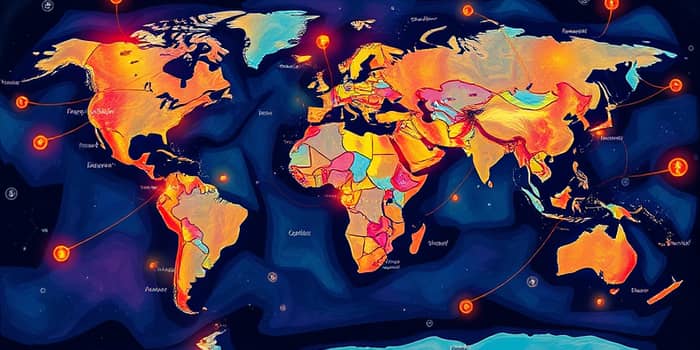
Every day, vast sums of money embark on journeys that link savers in one corner of the world to entrepreneurs in another. These capital flows are the unseen currents powering global growth, shaping economies, and revealing both opportunities and vulnerabilities.
From Savings to Investment: Understanding Capital Flows
At its core, international capital flows describe how money moves across borders for investment, trade finance, or official purposes. This movement reconciles a country’s savings with another’s thirst for investment, balancing global imbalances and stimulating economic activity.
Key types of cross-border capital include:
- Foreign direct investment (FDI): Long-term stakes and operational control, such as building factories abroad.
- Portfolio investment: Purchases of stocks, corporate bonds, government bonds without control over the enterprise.
- Other investment: Bank loans, deposits, and trade credits channelled through financial institutions.
- Official flows: Reserve accumulation, sovereign wealth fund moves, and multilateral lending.
In balance-of-payments accounting, the current account records goods, services, income, and transfers, while the financial account logs these capital movements. A deficit in one must be met by net capital inflows and outflows in the other.
Mapping the Landscape: Trends and Distortions
The story of global FDI in 2024–2025 illustrates both resilience and distortion. After two years of contraction, total FDI rose 14% in 2025 to $1.6 trillion. Yet, underlying growth was closer to 5%, once $140 billion of conduit flows via tax havens were removed.
Investor sentiment remains fragile: international M&A fell 10%, project finance value dropped 16%, and greenfield announcements were down 16% in deal count, though driven by a handful of mega-investments.
Regional dynamics varied sharply. Developed economies saw FDI surge 43% to $728 billion, with the EU up 56%. In contrast, developing nations experienced a 2% decline, and three-quarters of the least developed countries saw stagnant inflows.
The Hidden Routes: Tax Havens and Conduit Flows
Official data often mislocate where capital originates and lands. Many multinational firms route investments through subsidiaries in jurisdictions like Luxembourg, the Cayman Islands, and Ireland. This creates conduit and phantom FDI that masks the true economic destination of funds.
An NBER study highlights how traditional statistics follow legal ownership, not real economic activity. As a result, a flow recorded to an offshore center may actually finance a plant in Southeast Asia or a tech hub in Silicon Valley.
The United States: A Case Study in Financing a Structural Deficit
The U.S. exemplifies how a nation’s current account deficit is underwritten by global capital. For decades, oil exporters and East Asian surplus economies recycled their surpluses into U.S. Treasuries and corporate bonds, earning both security and yield.
Between 2000 and 2014, growth in foreign central bank dollar reserves paralleled the rise in U.S. external debt. But post-2014 shifts—dollar appreciation and lower oil prices—reshaped these flows, highlighting push vs pull factors such as quantitative easing abroad and strong domestic institutions.
Navigating the Future: Risks and Opportunities
As capital flows evolve, policymakers and investors face a complex environment shaped by geopolitics, regulatory shifts, and technological change. To harness benefits while mitigating risks, consider the following strategies:
- Enhance transparency: Strengthen reporting standards to reduce offshore financial centers distortions.
- Diversify funding sources: Blend FDI, portfolio, and domestic financing to buffer volatility.
- Adopt macroprudential measures: Manage sudden stops by building countercyclical capital buffers.
For investors, focusing on jurisdictions with robust rule of law, stable institutions, and clear regulatory frameworks can align long-term returns with societal impact. For nations seeking capital, improving governance, reducing uncertainty, and investing in human capital attract more sustainable flows.
Ultimately, tracing money’s global journey reveals a tapestry of ambition, risk, and innovation. By illuminating both the visible and hidden channels of cross-border finance, we can better design policies that channel resources where they are needed most, fostering growth that uplifts communities everywhere.
References
- https://www.capitalflowsresearch.com/about
- https://unctad.org/news/global-foreign-investment-14-2025-growth-concentrated-developed-economies
- https://www.cfr.org/articles/mapping-capital-flows-us-over-last-thirty-years
- https://www.iif.com/Products/Capital-Flows-Tracker
- https://www.trustintelligence.co.uk/investor/articles/strategy-investor-following-the-flow-where-global-capital-is-looking-next-retail-nov-2025
- https://www.youtube.com/channel/UCha3NmOiGa5aWIINXpv8lPg/posts
- https://unctad.org/publication/world-investment-report-2025
- https://www.capitalflowsresearch.com/p/macro-report-a-storm-is-coming
- https://www.youtube.com/watch?v=Z49WBy10EH8
- https://www.statestreet.com/us/en/insights/etfs-2025-outlook
- https://www.federalreserve.gov/econres/notes/feds-notes/globalization-and-the-geography-of-capital-flows-20190906.html